
Home · Science · Oct 28 archive
Astronomers Spot Atmosphere on Dwarf Planet Beyond Pluto
· Confirmed
In Short: Astronomers have discovered an atmosphere on a dwarf planet candidate beyond Pluto, the second known TNO with an atmosphere.
A team of astronomers in Japan has identified a dwarf planet candidate beyond Pluto that has an atmosphere, a rare discovery in the Kuiper Belt.
The object, dubbed 2002 XV93, is about 311 miles across, roughly a fifth of Pluto's diameter.
Ko Arimatsu, an associate professor at the National Astronomical Observatory of Japan, led the team that observed 2002 XV93 during a stellar occultation in January 2024.
The observation showed a smooth change in the star's brightness, indicating the presence of a thin atmosphere around the object.
"The observation data showed a smooth change of the star’s brightness near the edge of the shadow, lasting about 1.5 seconds," Arimatsu told CNN.
"This kind of smooth brightness change is naturally explained if the starlight was bent by a very thin atmosphere around the object," Arimatsu added.
The atmosphere around 2002 XV93 is estimated to be five million to ten million times thinner than Earth's atmosphere.
Meanwhile, another team of astronomers has discovered what could be the sixth dwarf planet in our solar system.
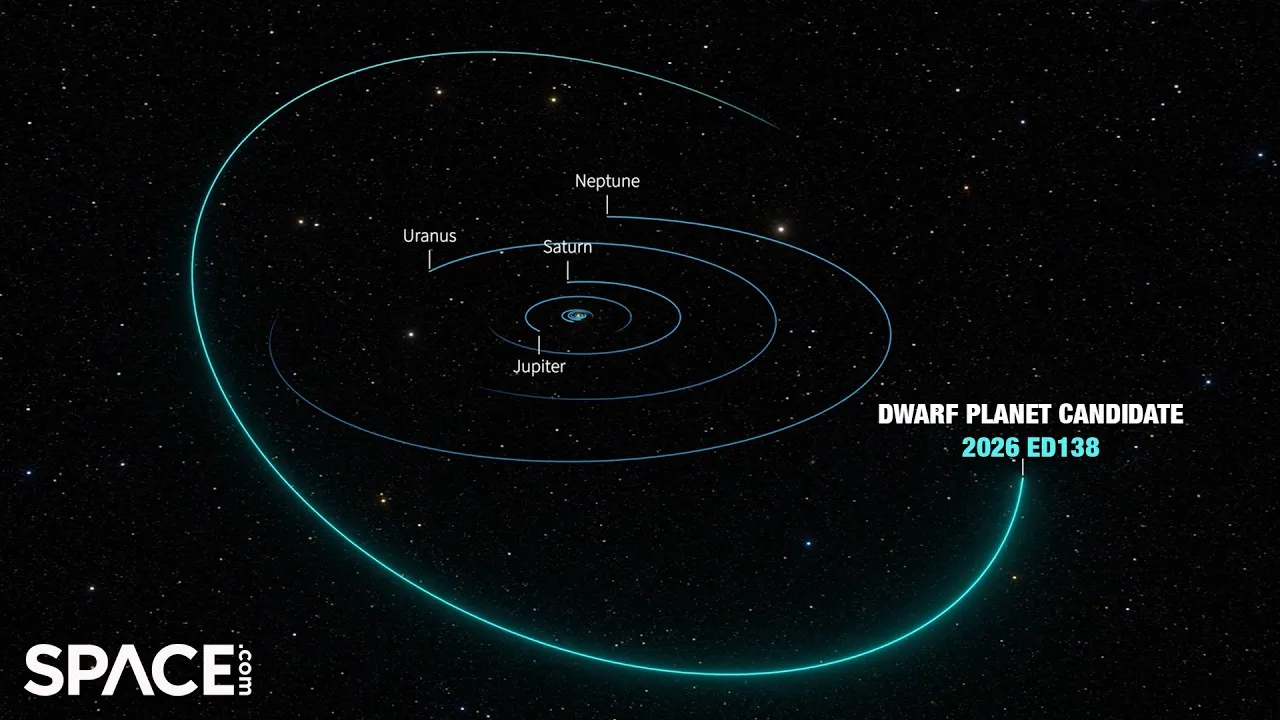
The object, named 2026 ED138, was spotted by the Vera C. Rubin Observatory and has a diameter between 600 and 1,500 kilometers.
"It’s the largest trans-Neptunian object found in about 20 years, and Rubin turned it up while we were still commissioning the telescope," Mario Jurić, an astronomer at the University of Washington, said.
"Finding an object this big, roughly 1,000 kilometers across, is something that happens maybe once in a generation," Jurić added.
The discovery of 2026 ED138 suggests that small icy worlds beyond Neptune may not be as inactive or unchanging as previously thought.
What's confirmed
- "Objects like this are very rare, so I immediately started checking whether I or the code had done something wrong." Everything we have managed to learn so far about the Solar System beyond Neptune (about 30 astronomical units from the Sun) indicates that there's a lot more out there than meets the eye.
- Astronomers may have just discovered our solar system’s sixth dwarf planet Located farther away from Earth than Pluto, the object was hidden in the light of the Milky Way’s stars In the outer reaches of our solar system, beyond the orbit of Pluto, the Vera C.
- Astronomers announced the discovery of a possible sixth dwarf planet beyond Pluto on 27 October 2026, after Matthew Holman identified the distant object in data from Chile's Vera C.
What's still developing
- As detailed in a paper published in the journal Nature Astronomy this week, the researchers say they’ve identified a minor planet only about 311 miles across — roughly a fifth of Pluto’s diameter — that’s wrapped in an extremely thin envelope of gases.
- Can’t-miss innovations from the bleeding edge of science and tech Astronomers have long been fascinated by the unusual behavior of objects orbiting the Sun in the Kuiper Belt, a scattered disc of minor planets beyond the orbit of Neptune.
- Artist's impression of CD-35 2722, red dwarf in the distance, brown dwarf close up, and the newly discovered sub-Jupiter that orbits the brown dwarf between.
- The first known "exomoon", if you will. With more than 6,000 exoplanets (planets orbiting stars besides the Sun) now discovered, some astronomers have turned their attention to finding exomoons, ie natural satellites that orbit those planets or other non-stellar objects. Today, Kevin Hoy, a PhD student at Diego Portales University in Chile, and his colleagues have announced the clearest potential signal for one of these exomoons yet spotted. But the question of whether it actually counts as a "moon" could come down to a matter of definitions.
- After considering several explanations, Hoy and his colleagues conclude that an object about 90 percent as massive as Jupiter in an orbit lasting 170 days around the brown dwarf fits the data almost perfectly.
- For many years, scientists have reconstructed the space beyond Pluto from breadcrumbs – scattered discoveries and indirect clues gleaned from the motion of those objects we have actually detected.
- Then, they looked further back – and found the object hiding in archival observations from the Dark Energy Camera, dating all the way back to February 2016.
- Scientific American is affiliated with LabX Media Group, which owns or has commercial relations with other B2B and B2C brands (many of them can be found at www.labxmediagroup.com ).
- Researchers calculated the strength of the magnetic field of the planet to be at least 1.25 kilogauss (kG) based on the highest frequency detected.
- β Pictoris b is a huge, hot planet similar to Jupiter that orbits around a bright star called β Pictoris, which is located approximately 63 light-years from Earth.
- They protect a planet’s atmosphere from being stripped away by the sun’s (or another star’s) “wind.” They also store information about the inside of the planet, such as whether it has a liquid core or a layer of material that can conduct electricity.
- However, this study discusses how UCDs could be prime targets since astronomers have been detecting radio waves from them for several decades.
Sources
- Futurismlink
- IFLSciencelink
- International Business Times UKlink
- Notebookchecklink
- Science News Exploreslink
- ScienceAlertlink
- Scientific Americanlink
- Space.comlink
- The Daily Galaxylink
- WPSD Local 6link
- ZME Sciencelink
- wyomingnewsnow.tvlink
- Techexploristlink
- Universe Todaylink
- Scilink
- Phys.orglink
- VideoFromSpace — video link