
Home · Science · Oct 27 archive
Nasa Announces Artemis III Crew for 2027 Lunar Orbit Mission
· Confirmed
In Short: Nasa has announced details for its Artemis III mission, set to launch in summer 2027, with a crew of four astronauts who will orbit the Moon for up to 17 days.
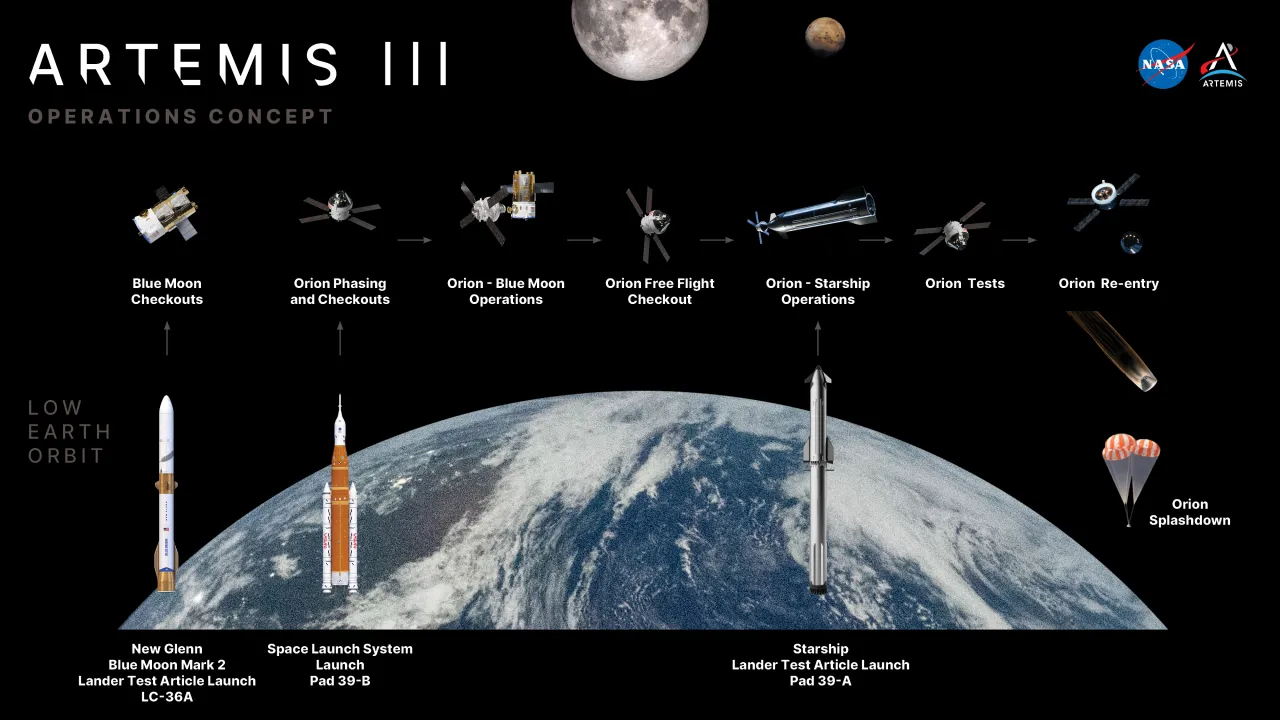
Nasa has announced the crew for its Artemis III mission, which is set to launch in the summer of 2027. The mission will last for 14 days, with the possibility of extending to 17 days if needed.
Artemis III will not involve a landing on the Moon but will instead orbit it, paving the way for the Artemis IV mission, which is scheduled for 2028 and will see astronauts land on the lunar surface for the first time since 1972.
The mission will involve the launch of three massive rockets: Blue Origin's New Glenn, SpaceX's Super Heavy-Starship, and NASA's Space Launch System. The crew will practice rendezvous, docking, habitation, and operational procedures essential for future lunar landings.
NASA Administrator Jared Isaacman emphasized the complexity of the mission, stating, 'We will not delude ourselves into believing that more time, more money, and flying less will somehow make our work safer or more achievable.'
The mission will use the Orion capsule, the same type of spacecraft used for the Artemis II mission, which saw astronauts fly around the Moon and back to Earth.
Both SpaceX and Blue Origin are racing to build the landers for Artemis III, with competition seen as a way to concentrate resources and achieve objectives more efficiently.
The mission will require the coordinated launches of three of the world's most powerful rockets. The Orion capsule will start in an elliptical orbit before moving to a circular orbit at 555 kilometers (345 miles) to meet with the lander.
NASA has rebuilt Artemis III around a single bold test: a crewed demonstration in low Earth orbit in 2027, with three spacecraft flying on three different rockets.
The mission will be pivotal in deciding whether SpaceX or Blue Origin supplies the lunar lander for the first crewed trip to the lunar surface in decades.
NASA Administrator Jared Isaacman said, 'We are executing President Trump’s National Space Policy to complete the long-awaited return of American astronauts to the lunar surface in 2028 and establish a Moon Base.'
What this adds
The mission will require the coordinated launches of three of the world's most powerful rockets: Blue Origin's New Glenn, SpaceX's Super Heavy-Starship, and NASA's Space Launch System.
Both SpaceX and Blue Origin are racing to build the landers for Artemis III, with competition seen as a way to concentrate resources and achieve objectives more efficiently.
If astronaut selection was purely random, the odds of a four-person, all-male crew would be about 10%, when taking into account the current reported gender breakdown of the active NASA astronaut corps.
Background
Nasa has announced details for its Artemis III mission, set to launch in summer 2027, with a crew of four astronauts who will orbit the Moon for up to 17 days.
What's confirmed
- Nasa reveals crew for Artemis III mission, which will not land on the Moon Nasa has announced more details about its next Artemis mission, which is set to launch in the summer of 2027.
- In terms of the in-orbit refuelling, a March 2026 report from the US Government Accountability Office found that Elon Musk's SpaceX had made "limited progress" maturing the technology.
- Artemis III has been described by Nasa as the most complicated mission it's ever attempted.
- “Once Starship operations are complete, Orion and the crew have the remaining days available for additional test objectives before needing to come home,” Parsons said during a press conference last week.
What's still developing
- The upper stage of its rocket, called "the Ship" is the prototype lander (although it has not yet been fitted out as a lander and lacks life support systems) and this will be placed in low Earth orbit.
- NASA reveals Artemis III crew that will take the next big step on its journey back to the moon In February, Isaacman, then a newly appointed NASA administrator, shook up the agency’s road map for a moon landing by adding a 2027 test mission.
- "Our last astronaut candidate class was greater than 50% female. We'll assemble the best astronauts to undertake and complete the objectives set up for the following mission."
- Major delays to Starship made the 2027 launch date uncertain, so in February NASA announced a complete change to the mission.
- As NASA returns humans to the lunar surface and establishes a long-term presence on our closest celestial neighbor, the agency and commercial human landing system providers Blue Origin and SpaceX have streamlined the designs and changed both concepts of operations for its future crewed landers.
- “When we pivoted to a low-Earth orbit mission, the SLS team quickly came back and said, ‘We don’t need the upper stage for that. Core stage has plenty of performance to drop us in the orbit we need,’” Parsons said.
- The Artemis program started in 2019 with the initial announcement that it would land the next man and first woman on the Moon.
- If astronaut selection was purely random, the odds of a four-person, all-male crew would be about 10%, when taking into account the current reported gender breakdown of the active NASA astronaut corps : 15 women and 21 men.
- A late 2027 launch would allow up to about 18 months of training together for this specific crew.
- "You need a launch pad. And for me, that launch pad is my country, Italy. Its education system, the Italian Air Force that gave me the professional tools to bring me here today. The Italian Space Agency that gave me the first flight to put those skills to proof."
- It will use its service module to perform a series of maneuvers to transition to a circular orbit at about 345 miles (300 nautical miles) for thermal stabilization before then gradually setting up its rendezvous with the waiting Blue Moon lander test article.
- The spacecraft can remain on orbit for up to 30 days providing schedule flexibility.