
Home · Science · Oct 27 archive
Nanotyrannus Skeleton 'Jodi' Sells for $47.3 Million at Auction
Confirmed
In Short: A rare 67-million-year-old Nanotyrannus skeleton nicknamed 'Jodi' sold for a record $47.3 million at a Sotheby's auction in New York.
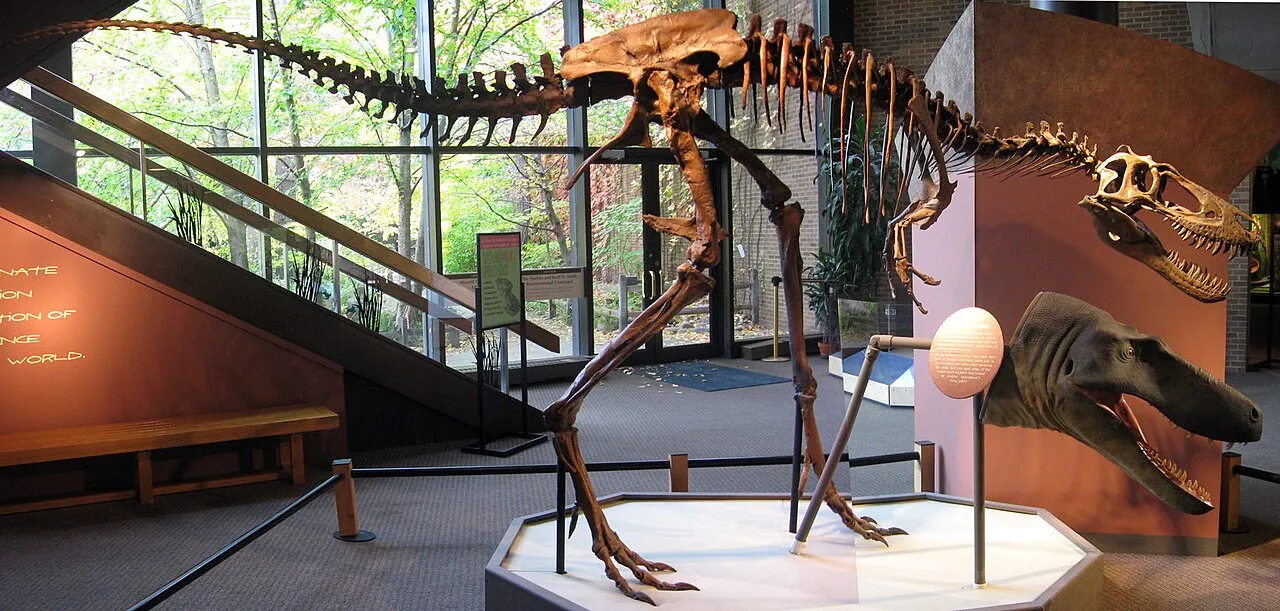
A rare 67-million-year-old Nanotyrannus skeleton nicknamed 'Jodi' sold for a record $47.3 million at a Sotheby's auction in New York on Tuesday, according to Sotheby's official auction listing and the Bozeman Daily Chronicle. The skeleton, which was estimated to sell for between $6 million and $9 million, is now the second most expensive set of dinosaur bones ever sold.
Jodi was discovered in 2019 by Montana rancher Jodi Pierson on privately owned land in the Hell Creek Formation near the town of Jordan, as reported by the Bozeman Daily Chronicle and A News (Türkiye). A team led by commercial paleontologist Clayton Phipps excavated the skeleton that year, and it was later acquired by a private collector.
The mounted skeleton, standing approximately 9.5 feet tall and measuring 19.6 feet from nose to tail, is exceptionally well-preserved, with about 191 fossil-bone elements and a virtually complete skull, according to Sotheby's and the BBC (United Kingdom).
Scientists identified more than 150 anatomical differences between Nanotyrannus and Tyrannosaurus rex, including longer arms, larger hand claws, and a greater number of teeth, as noted by A News (Türkiye). An adult Nanotyrannus measured approximately 5.5 meters (18 feet) long, compared to about 12.2 meters (40 feet) for an adult T. rex.
The sale of Jodi follows Sotheby’s July auction of the Tyrannosaurus rex “Gus,” which set a world record when it achieved $50.13 million, surpassing the $44.6 million paid for the Stegosaurus “Apex” in 2024 by billionaire Ken Griffin, according to the Observer. The sale of Jodi, at $47.3 million, is the second-highest price ever paid for a dinosaur skeleton.
Cassandra Hatton, Sotheby’s head of science and natural history, praised the team’s efforts as significant for science, stating, “Their commitment to understanding and preserving this remarkable specimen has helped bring us to this moment, a testament to the fact that we can all make major contributions to science.”
The new owner of Jodi has chosen to remain anonymous after outbidding five other prospective buyers online and by phone during the roughly 12-minute live auction, Sotheby’s said. Some scientists argue against private sales of fossils like Jodi, advocating for their display in museums for public and research access, as noted by Ticker News (Colombia).
Further evidence that dinosaurs are reaching collectors beyond the traditional fossil market came with “Trey,” a Triceratops skeleton dating back more than 66 million years to the Late Cretaceous, according to the Observer.
What's confirmed
- Jodi was discovered in 2019 by Montana rancher Jodi Pierson on privately owned land in the Hell Creek Formation near the town of Jordan.
- Measuring about 6 meters (19.6 feet) from nose to tail, the mounted skeleton stands approximately 2.9 meters (9.5 feet) tall on its display frame, according to the listing.
What's still developing
- That specimen, which shows the remains of a Nanotyrannus and Triceratops apparently in combat, was found eight miles (13km) away from Jodi in 2006.
- Prof Steve Brusatte, a palaeontologist at the University of Edinburgh and consultant on the Jurassic Park films, told BBC World Service's What in the World programme in July that the T. rex's auction was "concerning".
- Measuring 9.6 feet tall and 19.6 feet long, Jodi is just over half as long as Gus, with scarcity of similar specimens likely playing a role in pushing the sale price up.
- One of the first skeletons of T. rex was found there in 1902, and the name T. rex was given to the species based on fossils unearthed in the area.
- “We’ve really just found out that Nanotyrannus is real, and now one of the best skeletons is about to be sold to the highest bidder,” said Steve Brusatte, a professor of paleontology and evolution at Scotland’s University of Edinburgh, in an email.
- Acquired by the present consignor in 2021, “Jodi” was exhibited at Frieze Masters in 2023 by antiquities and fossil dealer David Aaron.
- But “the argument that no paleontology would happen or that dinosaurs wouldn’t be excavated if it wasn’t for the oligarch class buying dinosaurs at auction is a whole load of B.S.,” paleontologist Steve Brusatte said in an October 2026 Apollo article by Anna Brady on the growing commercial fossil market and the possibility that we’re in a fossil bubble.
- Research published last year confirmed Nanotyrannus as a distinct genus, settling long-standing debates about its classification.