
Home · Science · Oct 25 archive
NASA Speeds Up Lunar Lander Development for 2028 Moon Missions
· Confirmed
In Short: NASA is accelerating its lunar lander development with SpaceX and Blue Origin to return American astronauts to the Moon in 2028.
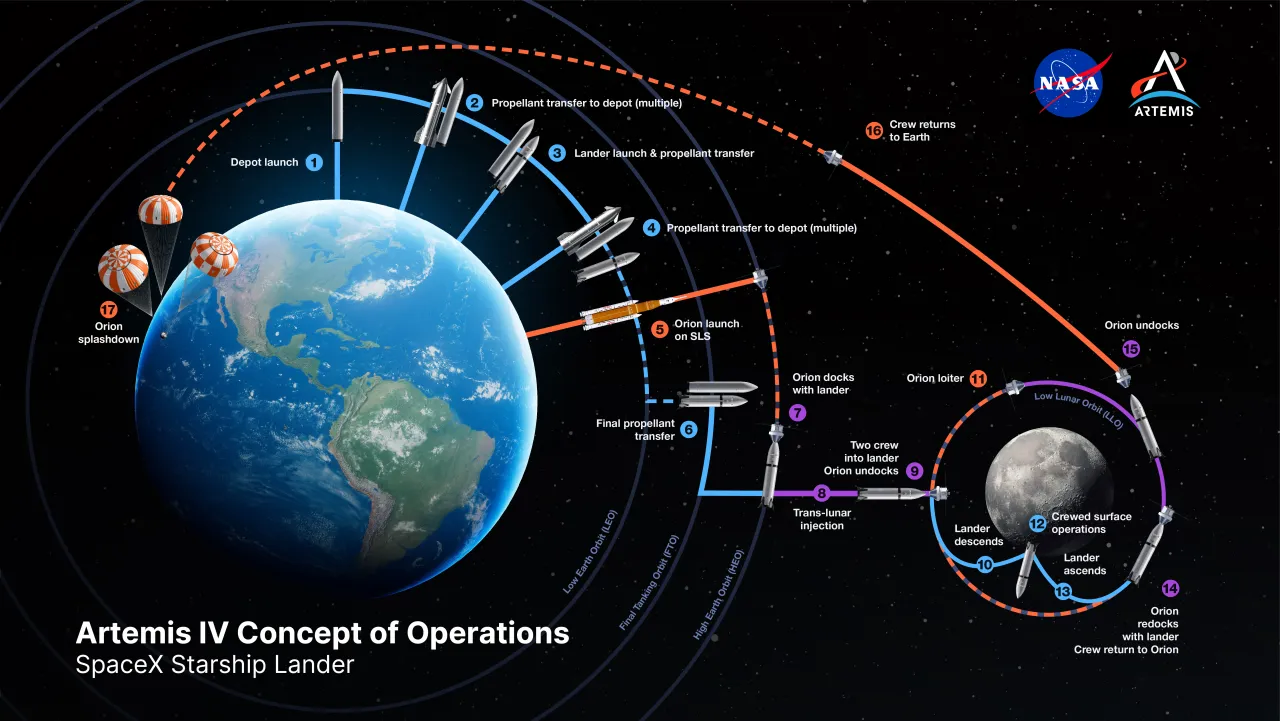
NASA Administrator Jared Isaacman announced Friday that the space agency is still on track to launch Artemis III next summer for a docking exercise with lunar landers from SpaceX and Blue Origin.
Orion will first dock with Blue Origin’s Blue Ghost about 270 miles above Earth, then with SpaceX’s Starship in a slightly lower orbit.
The Artemis III mission, featuring four astronauts, will be confined to orbit around Earth, with no moon landing this time.
Both landers will be launched next summer for docking practice by the three NASA astronauts and one Italian astronaut who will blast into orbit aboard NASA’s Orion capsule.
NASA is now accelerating its pace, eliminating endless meetings and bureaucratic inertia, as SpaceX, Blue Origin, and other companies scramble around the clock to meet deadlines.
NASA will keep its options open as long as possible before choosing between SpaceX and Blue Origin for the Artemis IV lunar lander.
Bob Smith, CEO of Blue Origin, said, “NASA’s Artemis program will be the next major milestone in the history of human spaceflight and we’re honored to be a part of it.”
NASA officials continue to anticipate launching the Artemis III mission by “summer” 2027.
The chart shared by NASA showed Orion docking with the Blue Moon lander in an elliptical lunar orbit, approximately 8,500 km above the Moon’s surface.
During the planned 14-day mission, crews and flight controllers will practice the rendezvous, docking, habitation, and operational procedures that will be essential when Artemis astronauts begin landing near the Moon’s South Pole in 2028.
NASA is also decoupling the lander from the launch vehicle and the pad itself.
Francis Halzen of the University of Wisconsin-Madison led the development of the IceCube Neutrino Observatory.
Background
NASA's efforts to accelerate lunar lander development include redefining Artemis III to include rendezvous and docking in low Earth orbit.
What's confirmed
- Administrator Jared Isaacman said Friday that the space agency is still on track to launch Artemis III next summer on a docking exercise with Elon Musk’s and Jeff Bezos’ lunar landers.
- More landers, rovers and orbiters will follow, so many that by the time the first Artemis moonwalkers arrive, their moon car will already be there waiting for them, according to officials.
- But the space agency is now accelerating its pace, he noted, eliminating endless meetings and bureaucratic inertia, as SpaceX, Blue Origin and other companies scramble around the clock to meet the deadlines and NASA bolsters its workforce.
- The two-week mission featuring four astronauts will be confined to orbit around Earth — no moon trip this time.
- Both landers will be launched next summer for docking practice by the three NASA astronauts and one Italian who will blast into orbit aboard NASA’s Orion capsule.
- NASA will keep its options open as long as possible before choosing between SpaceX and Blue Origin for the Artemis IV lunar lander, according to officials.
- "We are executing President Trump's National Space Policy to complete the long-awaited return of American astronauts to the lunar surface in 2028 and establish a Moon Base," said NASA Administrator Jared Isaacman.
- Japan is launching a spacecraft on a groundbreaking mission to bring back samples from Phobos, one of Mars' moons.
What's still developing
- In a media teleconference held Thursday afternoon, he was joined by Doug Loverro, associate administrator of NASA’s Human Exploration and Operations Mission Directorate, and Lisa Watson-Morgan, HLS program manager.
- President Barack Obama’s administration kept much of the Orion architecture and kickstarted the development of the Space Launch System (SLS) super-heavylift booster, but shifted NASA’s focus away from the Moon and onto other destinations, including an asteroid and eventually Mars.
- Although much of the information behind these plans has been previously reported at Ars Technica and elsewhere, this marked the first time NASA has laid them out in detail and acknowledged some substantial changes in the architecture.
- “We will not delude ourselves into believing that more time, more money, and flying less will somehow make our work safer or more achievable,” NASA chief Jared Isaacman said Friday in a press conference reaffirming the agency’s commitment to launching a low-Earth orbit test mission next year before a crewed lunar landing in 2028.
- The MatISSE 2024 projects will expand NASA’s portfolio of instrument technology available for the development of missions exploring a wide range of environments, from the hot surfaces of inner planets to the far-flung icy worlds on the edges of the Solar System.
- The flagship H3 rocket carrying the unmanned Martian Moons eXploration (MMX) probe blasted off into a pitch-black sky from the Tanegashima Space Center at 4.41am local time (3.41am Singapore time), according to a live-stream broadcast by the Japan Aerospace Exploration Agency (JAXA).
- The problem is that the SCP Foundation is a sprawling collaborate project of unclear origins and everything published at the SCP Foundation Wiki is released under a Creative Commons license that allows commercial use but requires it to be shared under the same license.
- Japan is preparing to launch the world’s first mission to collect and return samples from Phobos, one of the two small, irregularly shaped moons orbiting Mars.
- The deceased have been identified as German national of Indian origin Dhruba Jyoti Guha and Nepali Sherpa guide Phursemba Sherpa, according to the District Police Office, Gorkha.
- However, NASA Administrator Jared Isaacman said this of the estimate of 6 to 8 launches proffered by Musk: it was possible, but represented the “ultimate potential end state” of Starship.
- This required more energy and had other difficulties associated with it.
- A key question surrounding SpaceX’s architecture is the number of refuelings required to top off a Starship for a lunar mission.