
Home · Science · Oct 25 archive
NASA, Blue Origin, and SpaceX Speed Up Lunar Lander Development for 2028 Moon Missions
· Confirmed
In Short: NASA is accelerating the development of lunar landers with Blue Origin and SpaceX to achieve a 2028 Moon landing.
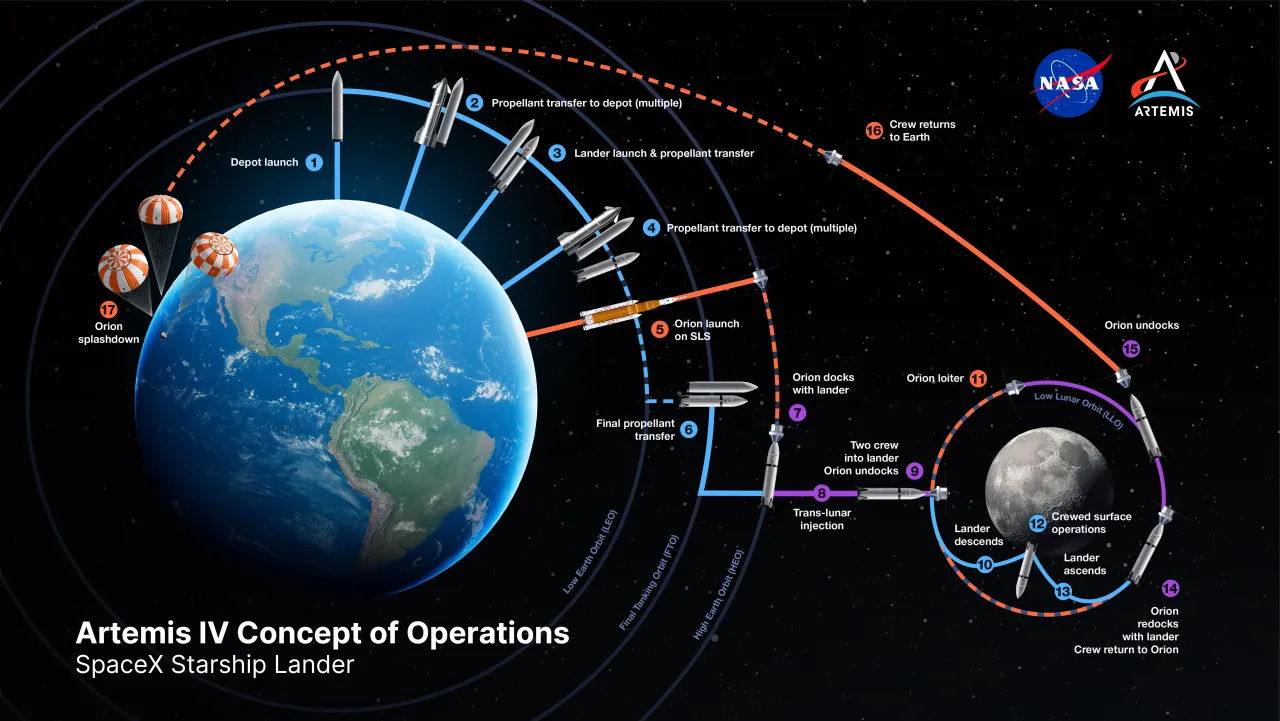
NASA announced on October 23 that it is speeding up the development of lunar landers with Blue Origin and SpaceX to ensure a successful Moon landing in 2028 and establish a Moon Base.
According to NASA Administrator Jared Isaacman, the agency is executing President Trump’s National Space Policy to complete the long-awaited return of American astronauts to the lunar surface.
Isaacman emphasized that NASA is not sitting idle, stating, “We are energized, our core capabilities are being rebuilt, our machine shops are running 24/7, and our experts are in the field attacking the critical path.”
Both companies are developing crew and cargo versions of their landers and must perform an uncrewed demonstration mission with their crewed landers before near-term crewed missions.
NASA has redefined Artemis III to include rendezvous and docking between test versions of the companies’ landers and the Orion spacecraft in low Earth orbit next year, rather than a near-rectilinear halo orbit around the Moon.
The agency and commercial human landing system providers have streamlined the designs and changed both concepts of operations for future crewed landers.
While the focus is on the Moon missions, other space-related developments are also underway.
For instance, ISRO outlined India's long-term ambitions under Space Vision 2047, including establishing the Bharatiya Antariksh Station by 2035 and undertaking an Indian crewed mission to the Moon by 2040.
In a separate development, NASA’s Roman Telescope lifted off, starting a mission to explore the universe’s biggest mysteries, including dark matter and dark energy.
SpaceX launched a Falcon 9 rocket early Saturday carrying a batch of data satellites for the U.S. military’s Space Development Agency (SDA), five days after a last-minute abort scrubbed the first attempt.
The collaboration between NASA and its partners highlights the importance of teamwork and innovation in achieving ambitious space exploration goals.
The renewed focus on lunar missions and space exploration reflects a broader trend in global space initiatives, with multiple countries and organizations working towards significant milestones.
What's confirmed
- “We are executing President Trump’s National Space Policy to complete the long-awaited return of American astronauts to the lunar surface in 2028 and establish a Moon Base,” said NASA Administrator Jared Isaacman.
- Both companies are developing crew and cargo versions of their landers and must perform an uncrewed demonstration with their crewed landers before near-term crewed missions.
- The agency has redefined Artemis III to include rendezvous and docking between test versions of the companies’ landers and the Orion spacecraft in low Earth orbit next year, rather than a near-rectilinear halo orbit around the Moon.
What's still developing
- Margaret Hamilton, the pioneering computer scientist who led software development for NASA ’s Apollo program and helped build the technology that took humans to the moon, has died at the age of 90.
- Also read: Harvard international student ban may return if Trump wins court battle: How Indian students could be affected She initially worked on software for uncrewed Apollo missions before moving into a leadership role on the software for crewed missions.
- Thursday, October 22, 2026 · 11:12 AM ET Updated 11:12 AM ET · 2:23 PM ET Confirmed In Short: Amazon is funding the development of a 960-megawatt nuclear plant in Sullivan County, Indiana, in partnership with American Electric Power and X-energy.
- A pipeline of titles is now in the works, spanning original productions, talent-driven projects and third-party development and consultancy assignments, with the first projects to be announced separately.
- Rockets accelerate by expelling propellant, forcing launch vehicles to carry fuel not only for their spacecraft but also to accelerate the remaining fuel.
- Two developments suggest there may be more than one route toward that goal.
- EMA has launched various initiatives to better embed women’s health considerations in medicines development and regulation.
- These stakeholders include EU regulators, patients, healthcare professionals, academia, the pharmaceutical industry and global partners.
- High-performance hardware from partners such as HP, Dell, Lenovo, Acer, and Asus, combines mobile convenience with desktop power.
- Adaptive development is how modern Android apps naturally scale across large displays, new device postures, and emerging form factors.
- At the postlaunch press conference, Nicky Fox, associate administrator of NASA’s Science Mission Directorate, said Roman could increase the number of known exoplanets from some 6,000 to 100,000.
- ISRO said it will continue to lead India's advanced space research, national and strategic missions, space science and exploration programmes, along with critical and frontier space capabilities.