
Home · Technology · Oct 24 archive
AI Solves Major Math Problem, Stirring Controversy
· Confirmed
In Short: Despite the controversy, the achievement marks a significant milestone in the use of AI in solving complex mathematical problems, potentially marking a fundamental turning point in how mathematicians tackle difficult problems.
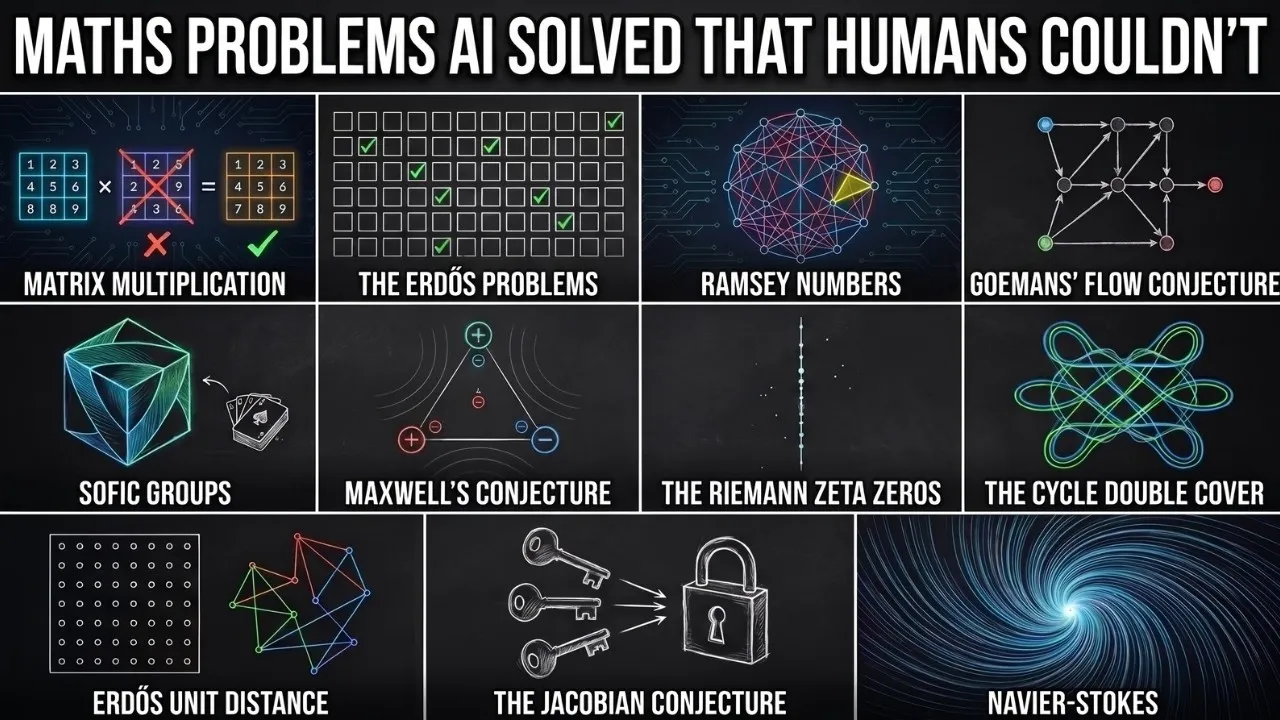
An artificial intelligence (AI) model developed by OpenAI has reportedly solved the Navier-Stokes existence and smoothness problem, one of the seven Millennium Prize Problems, according to a report by Finance.
The Navier-Stokes equations describe the motion of fluid substances and are central to many areas of physics and engineering. The problem asks whether these equations always produce smooth, physically meaningful solutions from smooth starting conditions, or if they can break down and develop singularities in finite time.
Charles Fefferman of Princeton University, who wrote the Clay Institute’s official description of the Navier-Stokes problem, expressed enthusiasm about the solution, stating, “I was thrilled that the problem was solved.”
TechCrunch reported that the AI model used an approach called “forcing,” which was originally developed by mathematicians Tristan Buckmaster and Luis Martínez-Zoroa.
However, the announcement has been met with controversy. Mathematician Tristan Buckmaster alleged that OpenAI had tackled the proof after becoming aware of his and his colleague Levent Alpöge’s work on a related problem.
The company is now setting up an independent advisory group of leading researchers in the field to address growing criticism from mathematicians.
Despite the controversy, the achievement marks a significant milestone in the use of AI in solving complex mathematical problems, potentially marking a fundamental turning point in how mathematicians tackle difficult problems.
The Navier-Stokes existence and smoothness problem is one of the seven Millennium Prize Problems, each carrying a $1 million bounty from the Clay Mathematics Institute for the first person or group to provide a solution.
What this adds
The report adds to the ongoing debate about the role of AI in solving complex mathematical problems, highlighting both the potential and the controversies surrounding such achievements.
Background
Mathematicians are grappling with a flood of new results from artificial intelligence, including potential solutions to longstanding Millennium Prize Problems.
What's confirmed
- An artificial intelligence (AI) model developed by OpenAI has reportedly solved the Navier-Stokes existence and smoothness problem, one of the seven Millennium Prize Problems, according to a report by Finance.
- The Navier-Stokes equations describe the motion of fluid substances and are central to many areas of physics and engineering. The problem asks whether these equations always produce smooth, physically meaningful solutions from smooth starting conditions, or if they can break down and develop singularities in finite time.
- TechCrunch reported that the AI model used an approach called “forcing,” which was originally developed by mathematicians Tristan Buckmaster and Luis Martínez-Zoroa.
- However, the announcement has been met with controversy. Mathematician Tristan Buckmaster alleged that OpenAI had tackled the proof after becoming aware of his and his colleague Levent Alpöge’s work on a related problem.
- The company is now setting up an independent advisory group of leading researchers in the field to address growing criticism from mathematicians.
- Despite the controversy, the achievement marks a significant milestone in the use of AI in solving complex mathematical problems, potentially marking a fundamental turning point in how mathematicians tackle difficult problems.
- The Navier-Stokes existence and smoothness problem is one of the seven Millennium Prize Problems, each carrying a $1 million bounty from the Clay Mathematics Institute for the first person or group to provide a solution.
What's still developing
- Petr Yan vs Merab Dvalishvili and Alexander Volkanovski vs Movsar Evloev (Image via Facebook/MMA Fighting) UFC 333 pre-fight press conference went ahead without any problems or confrontations.
- This began to change in 2013, when Thomas Hou of the California Institute of Technology and Guo Luo, now at the Hang Seng University of Hong Kong, derived a groundbreaking result showing that the Euler equations can “blow up,” as mathematicians like to say, in a cylinder if the top and bottom halves are set spinning in opposite directions.
- The proof of a “blowup” has blown up the mathematics community.
- “Ten years ago, nobody believed there was a singularity for Navier-Stokes,” said Córdoba — though many believed that the Euler equations did admit a singularity.
- "A month ago, we would not have expected to be talking about Millennium Problems," he said.
- OpenAI claims blockbuster math breakthrough amid swirl of controversy Prior to the announcement, rumors were circulating online among mathematicians over the proof’s origins—OpenAI has denied all allegations For the second time ever, someone has solved one of the seven Millennium Prize Problems —math’s biggest targets, each worth a $1-million prize.
- The night before OpenAI announced the proof, Buckmaster posted on social media that he and Alpöge, who is a mathematician and an employee of Anthropic, had blown up the Euler equations, widely seen by the field as a step toward solving the Navier-Stokes problem.
- Disrupt 2026: OpenAI, Anthropic, Replit, and more take over 6 industry stages. 25% off tickets now Back by popular demand: Save up to $300 on Disrupt NYU mathematics professor Tristan Buckmaster announced three proofs on Tuesday with a preliminary finding on one of the major unsolved problems in theoretical mathematics.
- “There is another part of this story,” Buckmaster wrote in his statement announcing the proofs, “and one that, honestly, I very much wish I did not have to be concerned with.” According to the statement, a parallel effort by OpenAI built on their work before it became public, leading to a tangle of academic rivalries and conflicting claims.
- But not before letting everyone know that a new internal model knocked out more than 100 long-standing math problems after just a month of training.
- "To put it another way, we have had to swallow the bitter lesson (which of course we were always aware was a distinct possibility, even if the speed at which it happened has taken us by surprise)."
- Get your daily rundown of Philly happenings in less than 10 minutes Philadelphia local news: Neighborhoods, politics, food, and fun Problems continue to pile up for the Ed Sheeran concert this Saturday.