
Home · Business · Oct 22 archive
French Bond Yields Near 2011 Crisis Levels Amid Debt Worries
· Confirmed
In Short: France's benchmark 10-year bond yield surged to near 5% this month, its highest level since 2002, as investors demanded greater compensation for lending to Europe's second-largest economy.
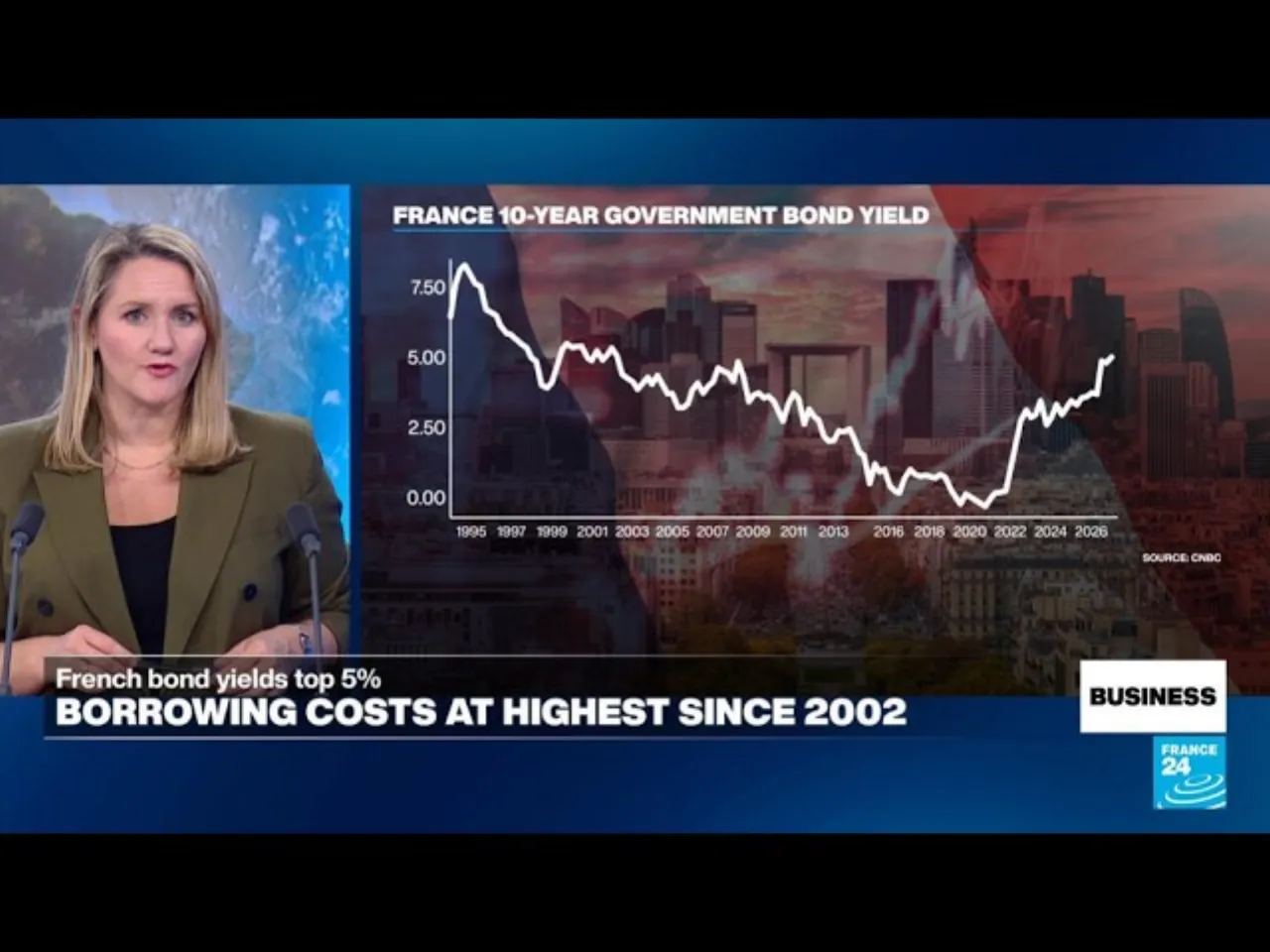
France's benchmark 10-year bond yield surged to near 5% this month, its highest level since 2002, as investors demanded greater compensation for lending to Europe's second-largest economy.
When French bonds sold off sharply at the start of October, Italian, Belgian, and Greek bonds fell in tandem, pushing borrowing costs to multi-year highs and reigniting fears of a new eurozone debt crisis.
Patrick Munnelly, market strategist at Tickmill Group, noted, “France had already been under pressure due to questions over fiscal credibility and political stability.”
The gap between French and German 10-year yields, a measure of how much more investors demand to lend to Paris than to Berlin, touched about 1.5 percentage points at one point Friday, the widest since the 2012 euro debt crisis.
France's risk premium climbed again Tuesday, with the 10-year spread over German bunds crossing 150 basis points and settling at 154, near the earlier monthly high of 159 basis points.
The euro slid Monday to the lowest level against the dollar in 17 months on worries about France's high debt and deficits, which have sent its government bond yields soaring.
Jeremy Peloso, a European macro strategist at BCA Research, said, “The severity of the French situation automatically focuses attention on fiscal issues.”
France's weakened government is struggling to secure parliamentary support for its budget and proposed deficit-reduction measures, with the welfare state facing significant challenges.
The country's debt now stands at nearly 120% of gross domestic product, according to Mishtalk, raising concerns about France's deteriorating public finances and political instability.
Background
France's benchmark 10-year bond yield surged to near 5%, its highest level since 2002, amid growing concerns over the country's fiscal stability and political gridlock.
What's confirmed
- The euro slid Monday to the lowest level against the dollar in 17 months on worries about France's high debt and deficits, which have sent its government bond yields soaring.
What's still developing
- This toxic mix of debt and dysfunction has made French bonds a target for what one strategist called "bond vigilantes"—investors who punish countries perceived as fiscally undisciplined.
- However, France's borrowing costs have increased faster than those of many comparable economies, suggesting investors are pricing in additional country-specific risks.
- Businesses started to rely on this competitive advantage.
- Downloadable PDFs are a benefit of an FP subscription.
- It fell after the financial crisis and stayed low and is beginning to look like what economists call a structural change.
- A lower risk-free rate is why many asset managers are rethinking the traditional 60-40 split of stocks-to-bonds they recommended to retail investors.
- Developing countries started buying more US and European bonds after the Asian financial crisis in 1997.
- "The French bond selloff illustrates how competition for capital is reshaping fixed income markets amid a global rate reset," BlackRock strategists including Wei Li wrote.
- That has rattled bond investors at a time when interest rates -- and hence borrowing costs -- are rising in developed economies worldwide to combat inflation.
- Exports of Middle East oil, excluding Iran, surpassed their pre-war levels last week despite attacks on ships in the Strait of Hormuz, according to data from the maritime tracking firm Kpler.
- The euro slid to as low as $1.1161, its weakest level since May 2025 in Asian hours after clocking four straight weekly declines, weighed down by France's debt levels and concerns about political gridlock ahead of next year's election.
- The gap is approaching levels last seen during the European sovereign debt crisis in 2011, although that comparison does not mean France faces an imminent debt crisis.