
Home · Science · Oct 21 archive
NASA's SpaceX Crew-13 Launches to International Space Station
Confirmed
In Short: NASA's SpaceX Crew-13 mission launched from Cape Canaveral Space Force Station, Florida, on Thursday morning, carrying four astronauts to the International Space Station (ISS) for a six-month science mission.
NASA's SpaceX Crew-13 mission launched from Cape Canaveral Space Force Station, Florida, on Thursday morning, carrying four astronauts to the International Space Station (ISS) for a six-month science mission. The Falcon 9 rocket, topped with an autonomously operated Crew Dragon capsule, lifted off from the launch pad at Kennedy Space Center, marking the 13th long-duration space station team NASA has flown aboard a SpaceX vehicle since May 2020.
The capsule, carrying NASA astronauts Jessica Watkins and Luke Delaney, Canadian Space Agency astronaut Joshua Kutryk, and Roscosmos cosmonaut Sergey Teteryatnikov, is on an eight-hour orbital voyage to the ISS. SpaceX mission control in Hawthorne, California, confirmed the separation of the Dragon capsule from the rocket and welcomed the crew to orbit.
The astronauts will support hundreds of scientific investigations during their six-month expedition, including numerous ISS National Lab-sponsored projects aimed at advancing biomedical innovation, fundamental science, STEM education, and technology development. The ISS orbits approximately 250 miles (400 km) above Earth, and the Crew Dragon is set to dock with the station around 7 p.m. on the same day.
The Crew-13 mission took flight aboard a SpaceX Falcon 9 rocket at 11:10 a.m., and the capsule successfully docked with the ISS in record time, completing the journey in just seven hours and 55 minutes. This marks the fastest launch-to-docking time for a U.S. spacecraft. The capsule's previous flights include launching 29 Starlink V2 Mini satellites and the Dragon Freedom on NASA’s SpaceX Crew-12.
NASA Administrator Jared Isaacman praised the mission, stating, “Crew-13 is another demonstration of America’s unmatched capability in human spaceflight and the strength of our commercial partnerships.” The mission is part of NASA’s Commercial Crew Program, which aims to open access to low Earth orbit and the ISS to more people, science, and commercial opportunities.
During their stay, the astronauts will work on projects that seek to benefit life on Earth and enable robust low Earth orbit activities. Jessica Watkins expressed her excitement about using the ISS as a platform for Earth observations and preparation for future missions to the Moon and Mars.
NASA will provide live coverage of prelaunch, launch, and docking activities, as well as audio-only discussions between the crew, the space station, and flight controllers during Dragon’s transit to the orbital complex.
What's confirmed
- By Joe Skipper, Steve Gorman and Joey Roulette / Reuters NASA astronauts Jessica Watkins, Luke Delaney, Canadian Space Agency astronaut Joshua Kutryk and Russian cosmonaut Sergey Teteryatnikov wave, on the day they depart for the launch pad at the Kennedy Space Center in Cape Canaveral, Fla.
- During their six-month expedition, NASA National Aeronautics and Space Administration astronauts Jessica Watkins and Luke Delaney, Canadian Space Agency astronaut Joshua Kutryk, and Roscosmos cosmonaut Sergey Teteryatnikov will support hundreds of scientific investigations, including numerous ISS National Lab-sponsored projects that seek to benefit life on Earth and enable a robust low Earth orbit (Abbreviation: LEO) The orbit around the Earth that extends up to an altitude of 2,000 km (1,200 miles) from Earth’s surface.
- EDT on October 1 from Space Launch Complex 40 at Cape Canaveral Space Force Station in Florida as part of NASA’s Commercial Crew Program.
- NASA will provide live coverage of prelaunch, launch, and docking activities for the agency’s SpaceX Crew‑13 mission to the International Space Station.
- The SpaceX Dragon spacecraft will carry NASA astronauts Jessica Watkins and Luke Delaney, CSA (Canadian Space Agency) astronaut Joshua Kutryk, and Roscosmos cosmonaut Sergey Teteryatnikov to the International Space Station for a long-duration science mission.
What's still developing
- “Over the next 24 hours, a weak low-level disturbance sliding along the south side of the high into the Gulf will bring breezy onshore flow that will continue into the primary launch window late Thursday morning,” launch weather officers wrote on Wednesday.
- The last Canadian who served onboard the space station was David Saint-Jacques who launched in December 2018 and returned to earth in June 2019.
- “I am super excited about using the I.S.S. as a platform for making observations of the Earth and what we can learn from that process as we take that to the moon,” Watkins said.
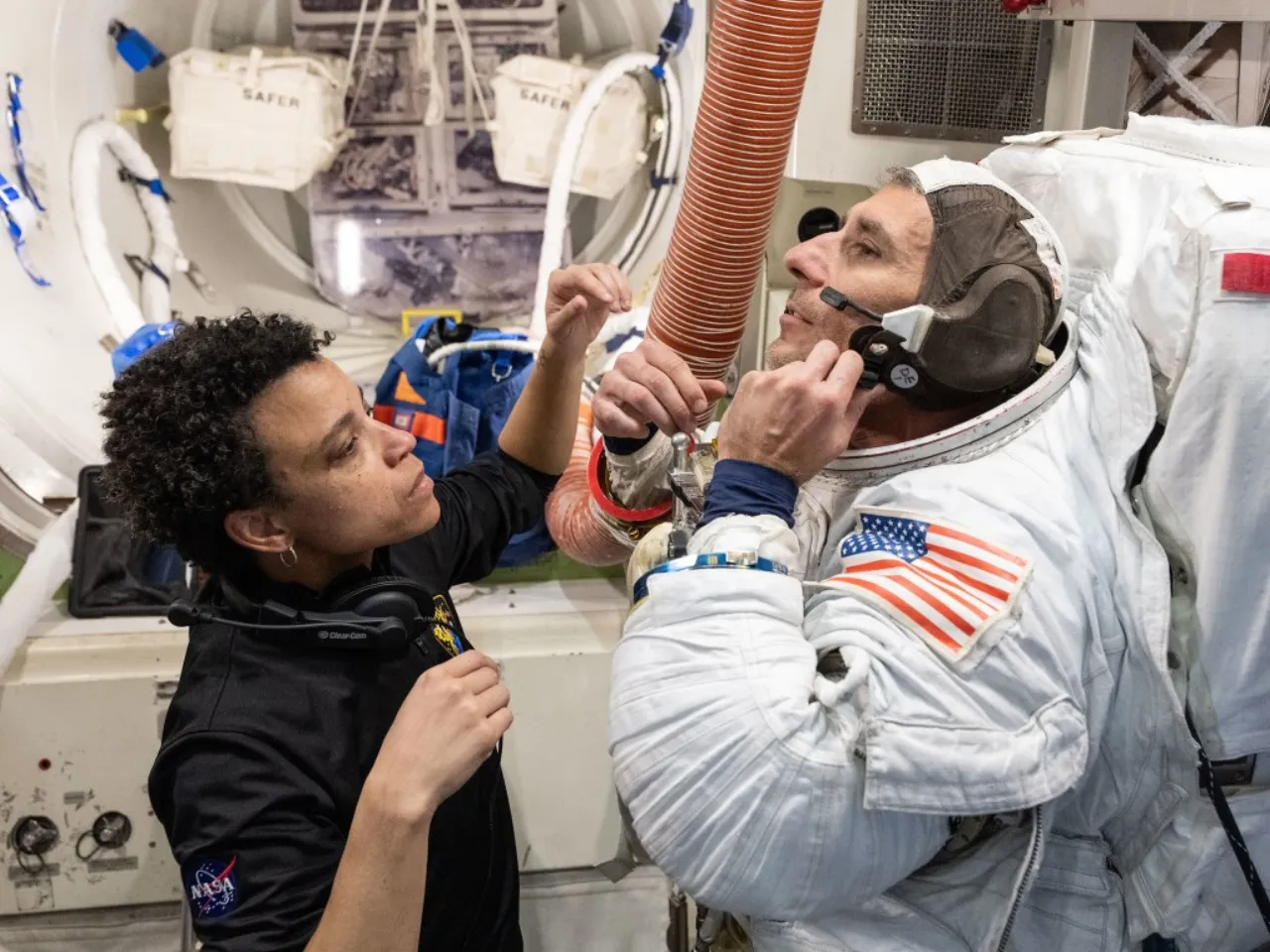
- The SpaceX Crew-13 members pose for a portrait in their pressure suits during a preflight training session.