
Home · Technology · Oct 21 archive
Chinese Firm Unitree Robotics Launches H2 Humanoid Robot
· Confirmed
In Short: Chinese robotics firm Unitree Robotics has launched the H2 humanoid robot, drawing global attention for its advanced capabilities.
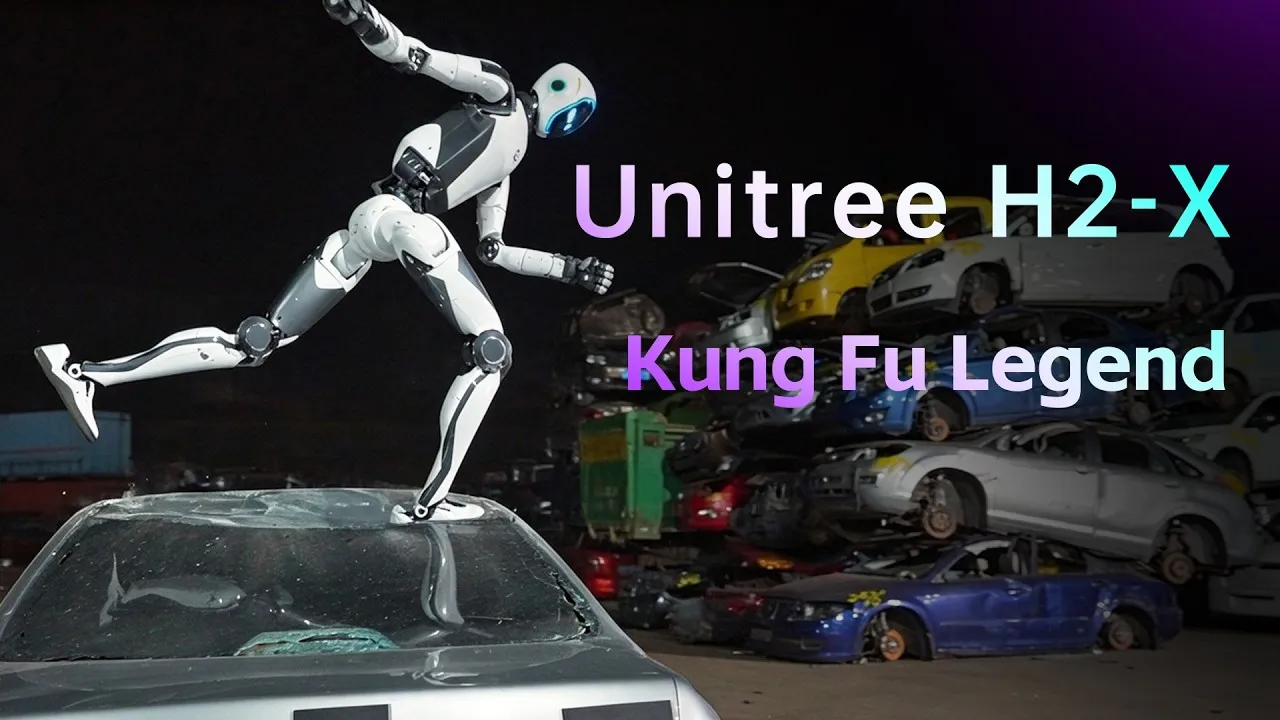
Chinese robotics firm Unitree Robotics has launched the H2 humanoid robot, drawing global attention for its advanced capabilities. According to a 2024 report by Kaiyuan Securities, Unitree shipped over 1,400 humanoid robots last year, making it the leading manufacturer by volume globally.
In a promotional video, the H2 robot performs a slow pirouette, drops into a martial arts stance, and strides forward with surprising grace. The robot, named H2, is the latest development from Unitree Robotics, and its design, complete with a static, human-like face and fully articulated limbs, has quickly drawn global attention.
Over the past two years, China has rapidly accelerated its development of bipedal humanoid robots, a niche once dominated by research labs and sci-fi imagery. Unitree, previously known for its quadruped robot dogs, has now entered the humanoid space with conviction.
H2 is just one among a growing class of humanoid platforms developed by firms like Ubtech and Zhiyuan Robotics, now being tested and sold for industrial use. For example, a baseline Unitree G1 humanoid robot sells for $13,500, while the Unitree R1 robot sells for $4,900.
China’s latest humanoid robot moves with uncanny precision, and it’s not just for show. The robot’s design, complete with a static, human-like face, has raised expectations for more than just functionality.
AGIBOT, another Chinese robotics firm, has delivered its 20,000th humanoid robot to Chimelong Spaceship Park, integrating more than 300 robots into entertainment, education, visitor services, and hotel operations.
According to the Federal Communications Commission, foreign-made “advanced robotic devices,” including certain mobile robots and humanoids, could create supply chain vulnerabilities and pose cybersecurity risks.
In July 2026, China’s Ministry of Industry and Information Technology said it expects China to manufacture more than 100,000 humanoid robots in 2026, a significant increase from just 14,000 humanoid robots produced worldwide in 2025.
Tesla has been facing challenges in scaling up production of its Optimus humanoid robots, with the company struggling to reliably manufacture the robots at scale due to intricate hands and issues with automated equipment and supplier constraints.
Despite these challenges, Tesla aims to produce over 1,000 Optimus robots per week by the end of 2026, but the company is currently producing several hundred per week.
Tesla’s Fremont factory in California has ceased production of the Model S sedan and Model X SUV, shifting resources to the development and production of Optimus humanoid robots.
One of the biggest challenges facing all robotics companies is getting enough training data to help robots visually learn a wide variety of manual tasks.
What this adds
The launch of the H2 robot by Unitree Robotics marks a significant milestone in China's rapid advancement in humanoid robotics, with the firm now competing globally.
While China is pushing humanoid robots into service roles, the United States is focusing on providing hands-on experience to students to prepare them for the future of robotics.
The growing presence of humanoid robots in various industries highlights the increasing importance of embodied AI and the need for robust cybersecurity measures.
Background
Meanwhile, in the United States, Bowling Green State University (BGSU) students are getting hands-on experience with new humanoid robots.
What's confirmed
- Tesla began converting former Model S and Model X lines at Fremont to assemble Optimus robots earlier this summer, aiming for a capacity of one million units per year as production ramps up.
What's still developing
- While the West showcases humanoids at tech expos, China is winning government contracts and pushing units into service roles.
- Mecka AI, a startup that collects and analyzes human motion data to train humanoid robots and other kinds of robots, announced it has raised a $60 million Series B round led by Sequoia, with participation from Nvidia, Microsoft’s venture fund M12, and others.
- Boston Dynamics' humanoid robot Atlas (Courtesy of Yonhap) Boston Dynamics Inc., the robotics unit of Hyundai Motor Group, said on Wednesday it plans to invest $100 million to build an advanced robotics and artificial intelligence center near its Waltham, Massachusetts, headquarters as it prepa Boston Dynamics’ humanoid robot Atlas South Korea’s Hyundai Motor Co.
- Kurt Knutsson, 'The CyberGuy', joins 'Fox & Friends' to showcase the World Humanoid Games in Beijing, China.
- Over 2,000 robots and 600 teams from 16 countries compete in athletic competitions including sprinting, boxing, and soccer.
- And if the robot looks like it walked straight out of "The Terminator," that was clearly the point.
- The event was staged by REK, a robotics entertainment company that puts remotely controlled humanoids into live combat events.
- He reportedly started against a smaller Unitree G1 before moving on to two modified EngineAI T800 humanoids.
- The initiative marks the delivery of the 20,000th humanoid robot to roll off AGIBOT’s production line, linking a major manufacturing milestone with one of the firm’s largest real-world applications in the tourism sector.
- Humanoid robots will be able to complete most general-purpose tasks from verbal instructions as soon as next year, although becoming useful around the house will take much longer, said the head of a leading Chinese company developing robot brains.
- After impressive hardware advances allowing Chinese humanoids to sprint, dance and do backflips on command, robot firms are increasingly focusing on the software that determines robots’ intelligence and enables them to do more economically productive tasks, a field known as “embodied AI”.
- Tesla is trying to build a library of basic movements the robot can recombine for new jobs, but the AI can’t yet reliably handle a wide range of tasks, and its behavior can be unpredictable in situations it hasn’t been trained on.