
Home · Science · Oct 19 archive
Mission blasts off for Mars to grab a piece of its moon
Confirmed
In Short: A Japanese spacecraft has launched from Japan on a mission to collect samples from Mars' moon Phobos and return them to Earth.
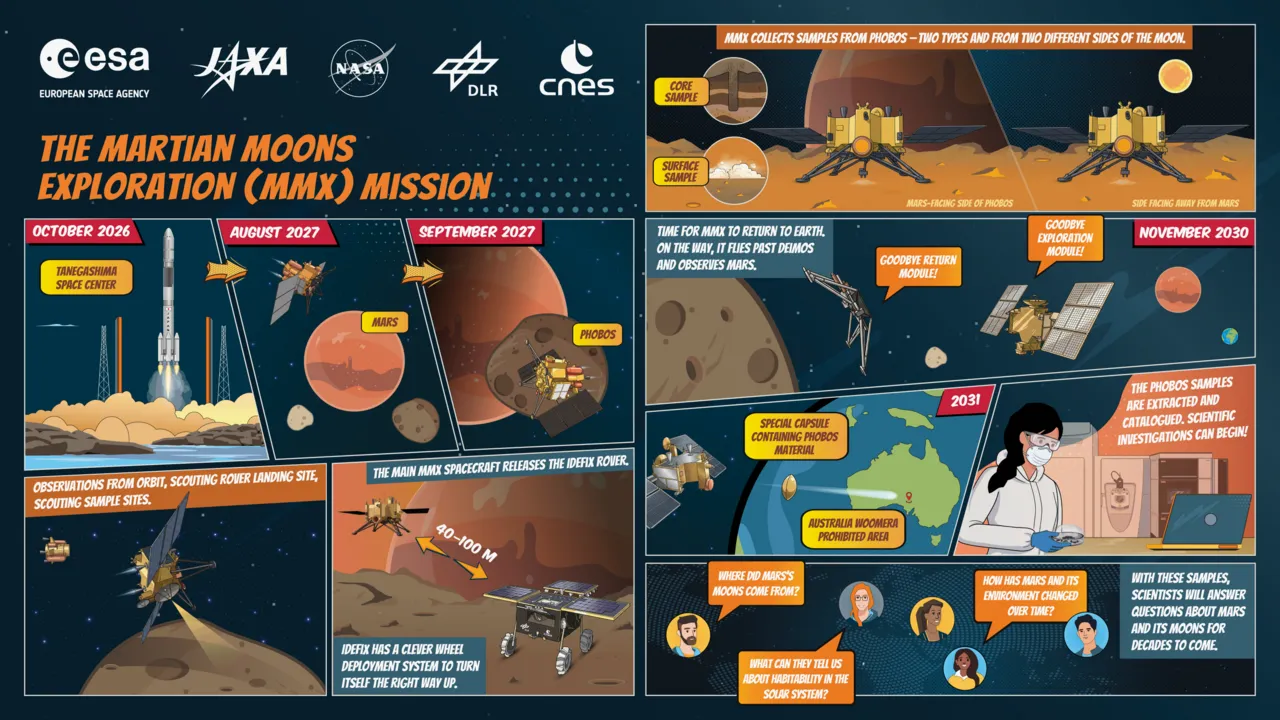
A Japanese spacecraft, part of the Mars Moons Exploration (MMX) mission, successfully launched from Tanegashima Space Center in southern Japan on October 20, 2023, bound for Mars' moon Phobos.
The mission aims to collect at least 10 grams of subsurface material from Phobos and return it to Earth for analysis.
Phobos, one of Mars' two moons, is irregularly shaped and has very little gravity, making the mission challenging.
The spacecraft will study both Phobos and Deimos, the smaller of Mars' moons, but will only land on Phobos.
The mission, led by the Japanese Space Agency (JAXA), is a collaboration with NASA, the European Space Agency, and other international partners.
The MMX spacecraft will orbit Phobos, deploy a lander, and collect soil and small pebbles.
Scientists hope the samples will provide insights into the formation of Mars' moons and the planet's history.
"When we get the sample back, we'll be able to look in detail at its chemistry and its mineral composition - and the two hypotheses will produce very distinct results," said Sara Russell, a scientist involved in the mission.
"It's a very small [amount] actually," said Dr Chrysa Avdellidou from Leicester University, emphasizing the value of even small samples.
The mission's success would mark the first time samples have been returned from Mars or its moons for analysis on Earth.
"The samples from MMX will bring forth paradigm-shifting science on the Mars system for generations to come, especially as NASA prepares to send the first humans to Mars," said Nicky Fox, associate administrator and Science Mission Directorate at NASA.
What this adds
The spacecraft is scheduled to arrive at Phobos in August 2027.
NASA's Perseverance rover has been collecting samples on Mars since 2021, but a plan to return these samples to Earth has been effectively cancelled due to funding issues.
What's confirmed
- The spacecraft is scheduled to arrive at Phobos in August 2027.
- "The moon itself doesn't have very much of its own gravity," she explained.
- NASA Details Contributions to Japan’s Martian Moons Mission Ahead of 19 October Launch NASA and the Japan Aerospace Exploration Agency (JAXA) are preparing to launch a mission to Mars’ two moons, Phobos and Deimos, with plans to return the first samples from a moon other than Earth’s to laboratories in 2031.
- NASA's mission is to pioneer the future in space exploration and scientific discovery.
What's still developing
- The Nasa Perseverance rover, which has been exploring Mars since 2021, has been carefully collecting samples on Mars and storing them in canisters.
- China is planning its own sampling mission to Mars, set to launch in 2028.
- "It should be pretty much immediately obvious.. whether it's the product of this dramatic impact or whether it's a captured asteroid. So we'll find that out really quickly."
- "And that means that the sample we get back may actually contain grains of Mars as well. So it can give us really direct information about the composition and history of Mars."
- They are also irregularly shaped, looking a bit like space potatoes.
- But a second Nasa/ESA mission, called Mars Sample Return, that would have picked up and returned these canisters, has been effectively cancelled, after its funding was halted by the US Congress.
- "However we can do several studies even on individual grains… You don't need to have kilos back from a surface in order to do science. So it's worth every gram," she said.
- Five of the world's space agencies joined forces for the five-year mission that will attempt to land a robotic prospector plus a rover on Phobos, the larger and closer of Mars' two pint-sized moons.
- Supporters argued the project had brought industries together behind a single planetary mission.
- Samples from Phobos will provide useful data for scientists to consider using a Martian moon as a base for a future manned mission to the planet, said MMX project manager Yasuhiro Kawakatsu.
- “NASA JPL’s Environmental Test Laboratory has been putting robotic explorers to the test since the Ranger program gave us NASA’s first up-close views of the Moon’s surface in the mid-1960s. We’re proud to provide our expertise and facilities to support this new phase of commercial lunar exploration,” said Charles Whetsel, manager, Exploration Systems Development Office at JPL.
- Japan’s ambitious mission to unlock the mysteries of Mars’ moons began its journey into deep space after a picture-perfect launch aboard the H3 rocket from the Tanegashima Space Centre.