
Home · Science · Oct 18 archive
NASA's Perseverance Rover Surpasses Mars Driving Record
Confirmed
In Short: NASA's Perseverance rover has surpassed the Mars driving record previously held by the Opportunity rover.
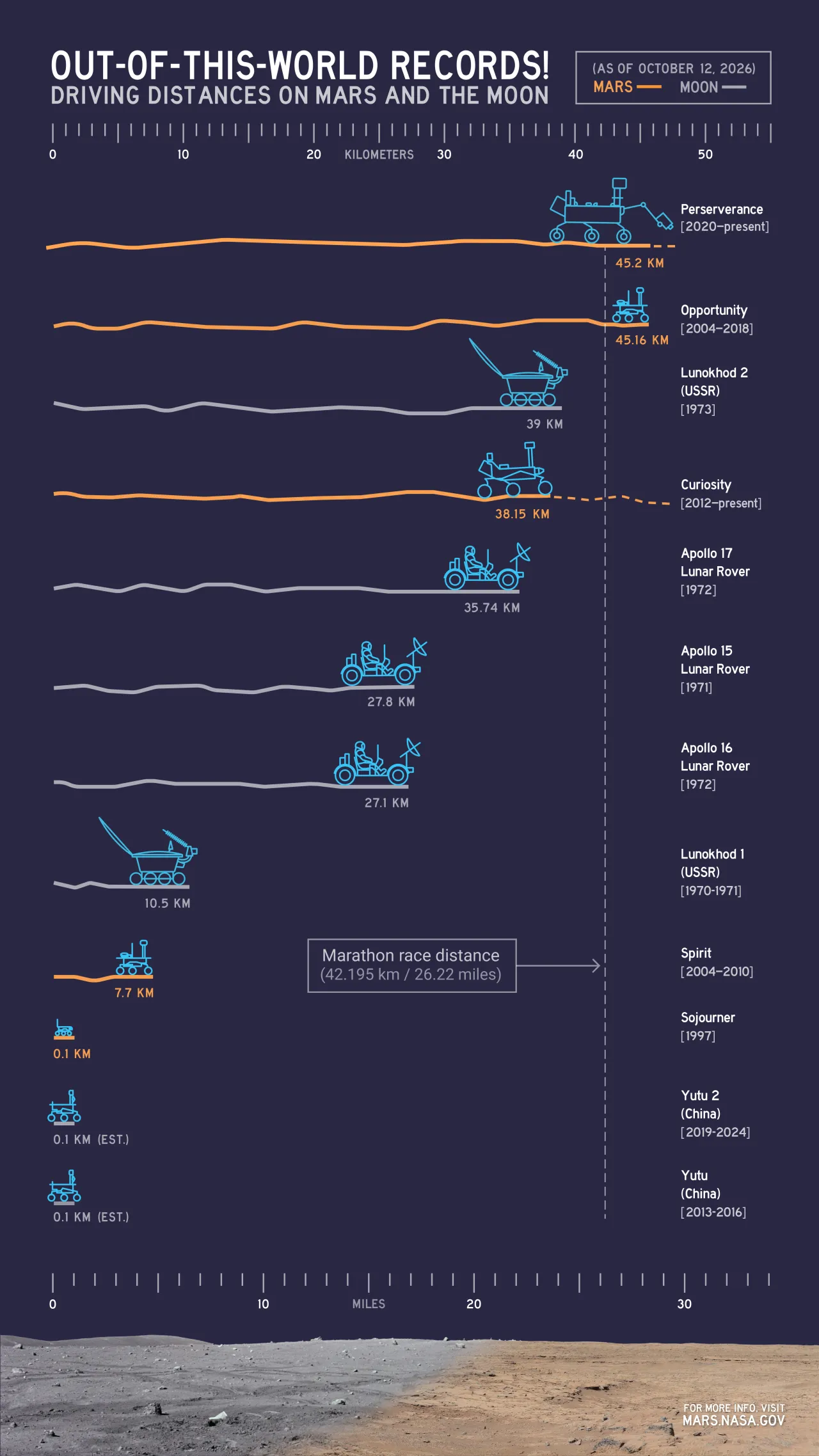
NASA's Perseverance rover set a new Mars driving record on October 11, surpassing the previous mark of 28.06 miles (45.16 kilometers) set by the Opportunity rover.
Perseverance's odometer reached 28.10 miles (45.22 kilometers), covering this distance in just over five and a half years, compared to Opportunity's nearly 15-year journey.
The rover's autonomous navigation system, AutoNav, plays a crucial role in this achievement. AutoNav allows Perseverance to image the terrain, build a 3D map of hazards, and plot its course autonomously, enabling it to cover up to 1,351 feet (412 meters) in a single Martian day, or sol.
Steven Lee, the project manager of the Curiosity and Perseverance rovers at NASA’s Jet Propulsion Laboratory, praised the technology's evolution, stating, “It is an honor to be working on Perseverance at a moment when the technology has evolved to the point that drives like these are routine.”
Perseverance's self-driving capability has allowed it to cover more than 90% of its total distance autonomously, compared to about 5% for Opportunity.
The rover's latest milestone came as it traveled toward an area called “Idubi” through the region off the western rim of Jezero Crater, nicknamed “Lac de Charmes,” where it is investigating some of the oldest terrain ever explored in the solar system.
NASA recently approved the mission’s first extension, which will carry Perseverance’s exploration of the crater rim through roughly the end of 2028.
Perseverance's navigation cameras captured a shot on October 11, 2026, the Martian day that a 299.6-foot (91.31-meter) drive pushed the rover’s total mileage past Opportunity’s record.
The rover's engineering systems and instruments remain in excellent condition, with redundant systems available, according to Lee.
NASA is testing Perseverance’s mobility systems to demonstrate their ability to support journeys of 100 kilometers or more, with additional hardware testing designed to simulate distances of 150–300 kilometers.
The microwave-oven-size Sojourner rover covered about 330 feet (100 meters) during its 83-sol mission in 1997.
What this adds
Perseverance has driven over 90% of its total distance using AutoNav, compared to about 5% for Opportunity.
Perseverance processes 600,000 measurement points with every look, a significant improvement over Sojourner's 20 measurement points.
The rover's autonomous navigation system is continuously being refined to improve its ability to navigate challenging terrain and extend its operational hours.
What's confirmed
- NASA’s Perseverance Mars rover has driven farther than any vehicle ever has on the surface of another world.
What's still developing
- Where NASA’s first Mars rover, Sojourner, assessed the path ahead using 20 measurement points, Perseverance processes 600,000 with every look.
- Perseverance rolled past both the 22.2 miles (35.7 kilometers) covered by Apollo 17 astronauts Gene Cernan and Harrison Schmitt in 1972 and the 24.2 miles (39 kilometers) driven by the Soviet Union’s Lunokhod 2 rover in 1973.
- That reach carried Perseverance from an ancient lakebed up a fossilized river system, where the rover found a potential biosignature at a rock called “Cheyava Falls,” and on to the crater rim, where an entirely different kind of ancient habitat — hydrothermal — may await.
- The rocks and terrain of Lac de Charmes are so ancient that their Earthly equivalents have long since been erased by erosion and plate tectonics (Mars doesn’t have tectonic plates), and Idubi is where the science team hopes to find traces of ancient hydrothermal systems.
- Exploring Mars for scientific discovery and to drive technologies enabling human exploration far from Earth.
- This animated orbital-map view shows the route NASA’s Perseverance Mars rover has taken from time of its 2021 landing to Oct.
- 11, 2026 — the day it broke the off-world driving record previously held by the agency’s Opportunity rover.
- Earlier Mars rovers had to pause more frequently to process information between driving segments.
- One of Perseverance’s most significant scientific findings has been the discovery of a potential biosignature, announced in 2025.
- The rover captures stereo images of the terrain ahead and uses them to construct a three-dimensional map.
- A dedicated Vision Compute Element processes images and runs the navigation software rapidly, allowing the rover to assess terrain almost continuously while driving.