
Home · Technology · Oct 15 archive
Tesla Roadster drives upside down, then lands a barrel roll
Confirmed
In Short: On Thursday night at SpaceX's McGregor, Texas site, Tesla ran the new Roadster up an inverted ramp on suction fans, spun a mid-air barrel roll on cold-gas thrusters, and clocked 0.81 seconds to 60 mph. Production is set for 2028.
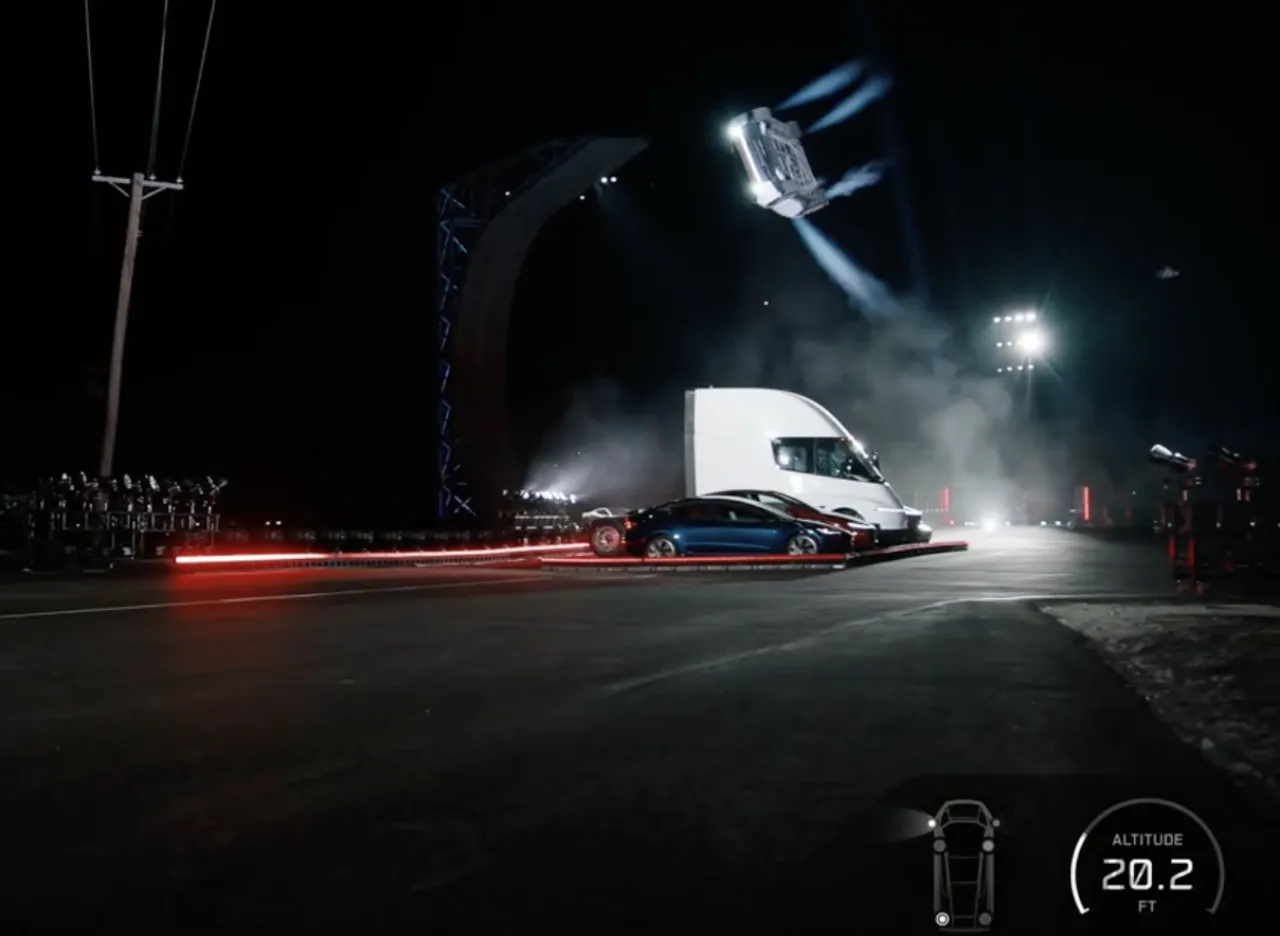
On Thursday night, Oct. 15, Tesla ran its second-generation Roadster at SpaceX's rocket development site in McGregor, Texas, outside Waco. The car drove up an inverted ramp, held to the surface by suction fans, then fired cold-gas thrusters, spun a barrel roll, and landed on its tires. A second pass lifted the car over a Cybercab, a Cybertruck, a Semi, a Model Y, and a Model 3, with another roll before it came down. Tesla showed one run from 0 to 60 mph at one second, then a second run at 0.81 seconds. The team said the pad was short, so they cut it. Musk said a production car should be quicker. The Austin American-Statesman, on the scene, reported his line when the car landed: "Well it worked!"
Lars Moravy, Tesla's vice president of vehicle engineering, said the suction fans under the car, supplied by SpaceX, can pull as hard as 2 Gs and let the car corner at up to 2 Gs. On the pass over the other Teslas, he called the move a kick flip. The fans have two modes, low-speed suction for traction and a high-speed mode that opens the front and rear of the system. Two tanks hold 600 liters of compressed air, about 250 kilograms, feeding 10 thrusters, and the car can recharge them. Musk said the car has attitude-control thrusters and main thrusters at the rear. "So it can basically fly like a rocket," he said. He also said the car on the pad is the car meant for the road, and that "it literally is just going to puff itself up and be able to do this, these maneuvers whenever you'd like." He called the night the work of Tesla and SpaceX engineers together, and "better than any James Bond car."
Tesla posted three versions as the livestream ended. Performance is the road car: two seats, active aerodynamics, and the multi-mode suction system, with a reservation of $50,000. Thrust is the race car: two seats and cold-gas thrusters at the rear, listed with a 0-to-60 time under one second, and a reservation of $250,000. Rocket seats one, puts thrusters around the body, and is invite only. Tesla lists more than 300 miles of range and a top speed above 230 mph. Musk named a later target of half the speed of sound, Mach 0.5.
Tesla described the Roadster as a pilot's car. Seats are molded into the chassis. Butterfly doors open on a two-seat cabin, with a yoke to the left of a wide screen. The rear wing switches between high drag and high downforce and can change its pitch on its own. The show car wears Ano White, an aerospace paint the company says carries ultraviolet and cryogenic protection, plus electrostatic dissipation and corrosion resistance. The glass is a gold tint meant to echo the copper coating on a spacesuit visor, with titanium accents. Headlights sit concealed, the taillight runs the width of the car, and the wheels are thin-spoked. Tesla said the shape takes from the SR-71 and the F-35.
Musk said production is 2028. Tesla has not named a retail price. He also said the company may try a later run at the Snake River Canyon, the gap Evel Knievel tried to clear. A Lotus Esprit, the car from The Spy Who Loved Me, which Musk owns, was on display at McGregor. The Statesman reported that the FAA had limited flights over about 1.5 nautical miles of the site for the outdoor demonstration, and that the program ran about half an hour.
Tesla first showed a second-generation Roadster in November 2017, at the end of the Semi unveiling. Thursday's car is the one the company now says it will build. The original Roadster, first delivered in 2008, is the car Tesla cites when it says an electric car could be fast and worth wanting.
What's confirmed
- Thursday night, Oct. 15, 2026, at SpaceX's McGregor, Texas rocket site, outside Waco.
- The Roadster drove an inverted ramp on suction fans, then barrel-rolled on cold-gas thrusters and landed on its tires.
- A second pass carried it over a Cybercab, a Cybertruck, a Semi, a Model Y, and a Model 3.
- Tesla showed a one-second run, then 0.81 seconds on a short pad. Musk said a production car should be quicker. Two tanks hold 600 liters of compressed air, about 250 kilograms, feeding 10 thrusters. The car can recharge them. Suction is up to 2 Gs.
- Performance reserves at $50,000, Thrust at $250,000, and Rocket is invite only. Range is listed above 300 miles, top speed above 230 mph.
- Musk said production is 2028.
What's still developing
- Tesla has not posted a retail price for the Performance, Thrust, or Rocket versions.
Sources
- TechCrunch — Sean O'Kane, from the McGregor demonstration, on the three versions and Moravy's air system. link
- InsideEVs — Mack Hogan, on the 0.81-second run and cornering at up to 2 Gs. link
- The Verge — Andrew J. Hawkins, on the kick flip, the air tanks, and the attitude thrusters. link
- Car and Driver — Eric Stafford, on the two acceleration runs, the wing, and the cabin. link
- Paul Tan — on Moravy's account of the tanks and on the short pad. link
- WIRED — Aarian Marshall, on the flight at SpaceX's McGregor site. link
- Austin American-Statesman — Andrea Guzmán, from McGregor. link