
Home · Science · Oct 15 archive
Oldest Known Spear Attack Found in Neanderthal Remains
Confirmed
In Short: While the exact cause of the wound remains unclear, researchers cannot rule out that it was the result of either a hunting accident or an intentional attack.
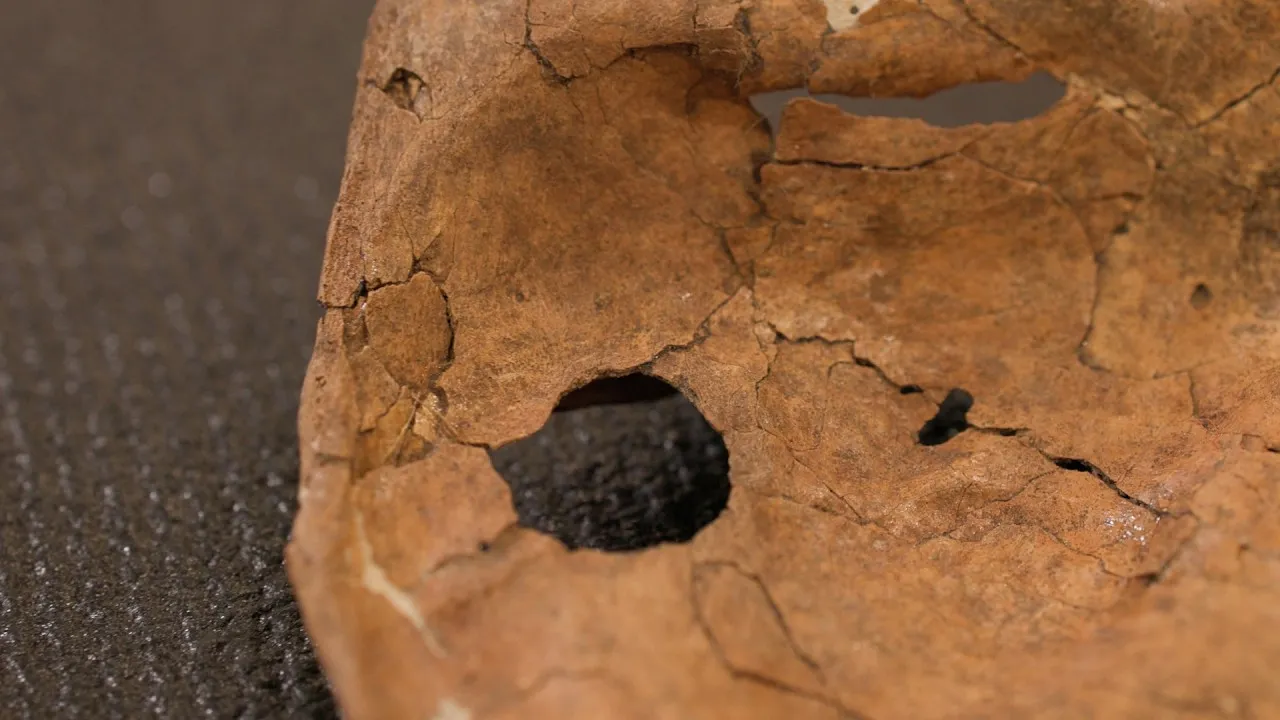
Researchers from the University of Cambridge have found a circular hole in the shoulder blade of a Neanderthal, suggesting a wound from a wooden spear, according to a study published in Scientific Reports.
The remains, known as Shanidar A, were excavated from Shanidar Cave, a site already renowned for changing perceptions of Neanderthal behavior.
The injury is consistent with a wooden spear entering from the front and passing through the chest, indicating a potentially fatal blow.
The cave has yielded remains of five Neanderthals, including Shanidar A, who was about 45 years old at the time of death.
The team found the shoulder blade alongside a mostly complete right hand, two ribs, and seven teeth, all from an adult about 45 years old.
The remains were recovered from under nearly eight meters of rock and sediment, close to a huge boulder near the cave entrance.
Emma Pomeroy, the study’s lead author, noted that the wound could be the first evidence for sharpened wooden spears in the prehistoric Middle East.
The discovery adds to the understanding of Neanderthal behavior, including evidence of care and violence.
The cave has been a site of significant archaeological interest since the 1950s, with previous findings suggesting intentional burial practices among Neanderthals.
The newly identified Shanidar A is one of 13 Neanderthal individuals whose remains have been found in the cave, some with signs of deliberate burial.
The repeated use of a single space to deposit the dead within a short time span suggests intentional patterned behavior, indicating a level of care during and immediately after death.
The discovery of Shanidar A adds to the argument that Neanderthals exhibited both care and violence, behaviors that are still present in human societies today.
What this adds
The exact cause of the wound remains an unsolved mystery, with researchers unable to definitively determine whether it was a hunting accident or an intentional attack.
The discovery of Shanidar A adds to the understanding of Neanderthal behavior, but does not conclusively prove the nature of the wound's cause.
What's confirmed
- Researchers from the University of Cambridge have found a circular hole in the shoulder blade of a Neanderthal, suggesting a wound from a wooden spear, according to a study published in Scientific Reports.
- The remains, known as Shanidar A, were excavated from Shanidar Cave, a site already renowned for changing perceptions of Neanderthal behavior.
- The injury is consistent with a wooden spear entering from the front and passing through the chest, indicating a potentially fatal blow.
- The cave has yielded remains of five Neanderthals, including Shanidar A, who was about 45 years old at the time of death.
- The team found the shoulder blade alongside a mostly complete right hand, two ribs, and seven teeth, all from an adult about 45 years old.
- The remains were recovered from under nearly eight meters of rock and sediment, close to a huge boulder near the cave entrance.
- Emma Pomeroy, the study’s lead author, noted that the wound could be the first evidence for sharpened wooden spears in the prehistoric Middle East.
- The discovery adds to the understanding of Neanderthal behavior, including evidence of care and violence.
- The cave has been a site of significant archaeological interest since the 1950s, with previous findings suggesting intentional burial practices among Neanderthals.
- The newly identified Shanidar A is one of 13 Neanderthal individuals whose remains have been found in the cave, some with signs of deliberate burial.
- The repeated use of a single space to deposit the dead within a short time span suggests intentional patterned behavior, indicating a level of care during and immediately after death.
- The discovery of Shanidar A adds to the argument that Neanderthals exhibited both care and violence, behaviors that are still present in human societies today.
What's still developing
- “I don’t think that’s something you do accidentally,” University of Cambridge biological anthropologist Emma Pomeroy noted, though the evidence cannot distinguish hunting from deliberate violence records The Guardian.
- “Conceivably it was a hunting accident,” co-author Chris Hunt said.
- The case adds a darker possibility to the story of a cave where Neanderthals repeatedly returned to place their dead.
- Whether the blow came during a hunting accident or an intentional attack remains an unsolved Stone Age mystery.
- Since 2015 the Cambridge team has found three more individuals there, bringing the total to five, four adults and an infant, packed into a space 1.5 meters (5 feet) long, 1 meter (3.3 feet) wide and 1 meter deep behind a large boulder.
- Waterlogged spears from Schöningen, Germany, date to around 200,000 years ago, and some top 2 meters (6.6 feet) and were shaped for throwing, much like a modern javelin, while the oldest known rounded wooden spear, more than 400,000 years old, survives only as a pointed tip found at Clacton-on-Sea in the UK.
- The only damage is a circular hole 15 millimeters wide, and the team says a sharpened wooden spear made it, since a flint or stone tip would leave a flat or angular opening.
- “They were someone’s son, daughter, partner, parent, relative, and it’s an immense privilege to study their skeleton, whether they died recently or tens of thousands of years ago,” Emma Pomeroy, the study’s lead author, told Discover.
- Read More: Neanderthals Faced a Genetic Crisis During the Ice Age, Setting the Stage for Their Extinction Ralph Solecki’s team found 10 Neanderthals at Shanidar Cave in the 1950s, including a man who was probably blind in one eye and partly deaf.
- “Shanidar A highlights the good and bad facets of human [behavior] — care and violence — which we are acutely aware of in the world around us, and shows us how deep those are in our evolutionary history,” Pomeroy told Discover.
- “It is astonishing that Shanidar Z lay there in the cave for 75,000 years, through all the great events of human history from then to now, and amazingly we were lucky enough and privileged enough to find her,” he told Discover.
- Yet the person had survived a severe facial injury, perhaps because others cared for them, a sign that the care and violence we see today also shaped Neanderthal lives.