
Home · Science · Oct 15 archive
Japan's MMX Mission Set to Launch to Unravel Mars Moons Mystery
Confirmed
In Short: On October 20, 2026, Japan's Martian Moons Exploration (MMX) mission is set to launch from Tanegashima Space Center in southern Japan, aiming to unravel the mystery of Mars' moons, Phobos and Deimos.
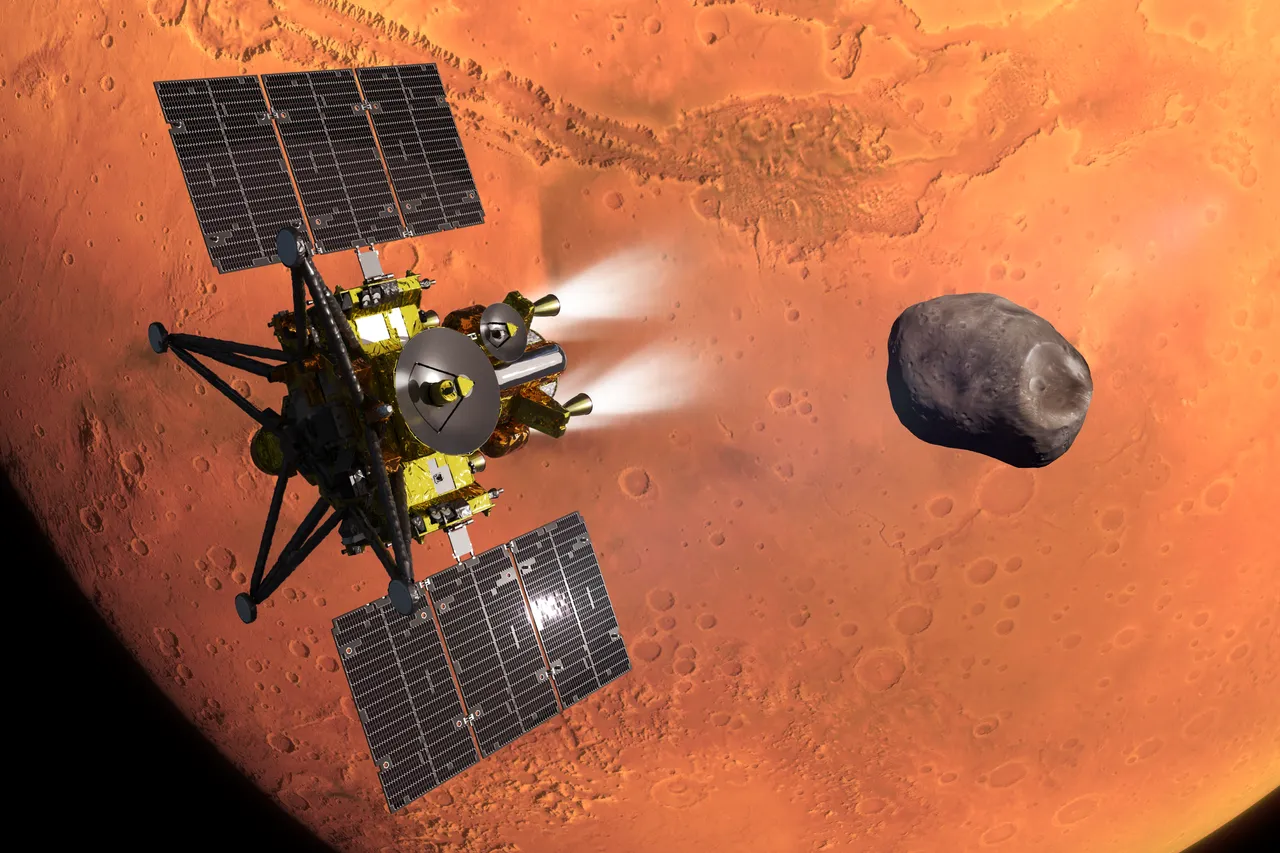
On October 20, 2026, Japan's Martian Moons Exploration (MMX) mission is set to launch from Tanegashima Space Center in southern Japan, aiming to unravel the mystery of Mars' moons, Phobos and Deimos.
Discovered in 1877 by American astronomer Asaph Hall, these moons remain enigmatic, with theories suggesting they may have originated from within or just beyond the asteroid belt between Mars and Jupiter.
The MMX mission, led by the Japan Aerospace Exploration Agency (JAXA), will land on Phobos to collect a soil sample, providing crucial data on the moons' origins and composition.
NASA is playing a significant role in the mission, contributing about 15% of the returned sample for research at the Johnson Space Center Astromaterials Lab in Houston.
The MMX spacecraft will arrive at Mars in August 2027 and begin its survey of the Red Planet's moons, with a sample collection from Phobos planned no earlier than December 2028.
The returned samples will be studied for decades, offering insights into the evolution of the Mars system and potentially shifting paradigms in planetary science.
NASA's contributions include the MEGANE gamma-ray and neutron spectrometer, the spacecraft's surface sampler mechanism, and navigation support from the agency's Deep Space Network.
The mission's success will not only enhance our understanding of Mars' moons but also pave the way for future human exploration of the Red Planet.
NASA's involvement underscores the international collaboration in space exploration, with the agency's Discovery Program funding the mission and supporting U.S. scientists on the MMX science team.
The MMX mission's findings will be invaluable for future generations of scientists, providing a wealth of data that will continue to be studied and analyzed long after the mission's completion.
What this adds
The mission's launch date is confirmed by both the European Space Agency and NASA, ensuring a coordinated international effort.
The MMX mission will provide the first sample return from Mars' moon system, marking a significant milestone in planetary science.
What's confirmed
- The Martian Moons eXploration ( MMX ) mission is set to launch into space on a H3 rocket from the Tanegashima Space Center at 04:41 JST on 20 October 2026 (20:41 BST / 21:41 CEST on 19 October 2026).
What's still developing
- This impact hurled molten rock into space, which eventually coalesced to form the satellite we can see every night from across our planet.
- This suggests that Phobos and Deimos were originally asteroids that wandered so close to Mars they were captured by the planet’s gravity.
- An ESA image release confirming successful launch will be issued on 20 October.
- Just like Earth, Mars has changed a lot since it formed 4.5 billion years ago.
- Despite the large fleet of missions sent to the Red Planet, the moons remain particularly mysterious, with huge open questions about how they formed and what they are made of.
- “The samples from MMX will bring forth paradigm-shifting science on the Mars system for generations to come, especially as NASA prepares to send the first humans to Mars,” said Nicky Fox, associate administrator, Science Mission Directorate, NASA Headquarters in Washington.
- NASA-supported researchers are working alongside international colleagues to help reveal the story of Phobos and will use mission data and returned samples to uncover new clues about the moon’s origin and the evolution of the Mars system.
- They present it in a research letter titled " The dynamical surface of Phobos: A morphodynamic atlas," published in Earth and Planetary Science Letters.
- "In such a low-gravity regime, the displacement of loose material, like regolith, cannot be inferred from topographic slope alone, making a dynamical approach essential for interpreting Phobos’ surface morphology and for supporting the Martian Moons eXploration (MMX) mission led by JAXA."
- A lot of advance work goes into a sample return mission.
- Not from Mars itself, but from its largest moon Phobos.
- Audio of the media teleconference will stream on the agency’s website at: Participants in the briefing, who will provide an overview of the mission and NASA’s contributions, include: Media interested in participating by phone must RSVP no later than two hours prior to the start of the teleconference to Molly Wasser at molly.l.wasser@nasa.gov.