
Home · Science · Oct 9 archive
NASA Advances PRIMA Mission, SpaceX Launches CRS-35 to ISS
Confirmed
In Short: NASA has advanced the PRIMA mission into Phase B development and SpaceX launched its 35th resupply mission to the International Space Station on Tuesday, October 13, 2026.
NASA announced on Wednesday that it has selected the PRIMA mission for Phase B development, a significant step in advancing the mission's preliminary design and technology development. The mission, recommended by the National Academies of Sciences, Engineering and Medicine in its 2020 Decadal Survey, aims to study the origins of planets outside the solar system, the growth of galaxies, and the buildup of dust and heavy elements over cosmic history.
Goddard Space Flight Center manages NASA’s Explorers Program, the agency’s oldest continuous program, which has launched more than 100 missions since Explorer 1 in 1958. If PRIMA clears its confirmation review, NASA will cap its project cost at $1.2 billion, excluding launch and other non-project costs. The mission is targeted for a 2033 launch and will operate for a planned five-year period.
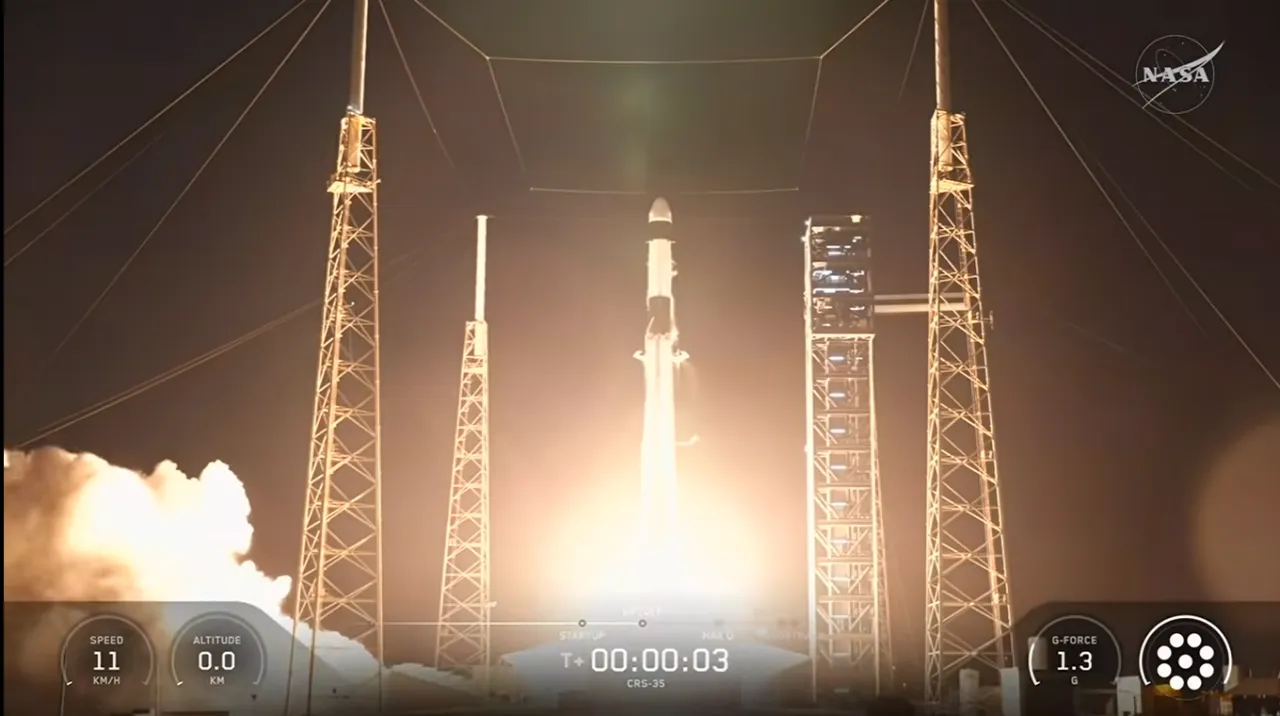
On Tuesday, SpaceX launched its 35th Commercial Resupply Services mission (CRS-35) to the International Space Station from Cape Canaveral Space Force Station. The mission, which is the fourth flight for the Dragon spacecraft supporting this mission, is expected to dock with the space-facing port of the ISS Harmony module on Thursday.
The CRS-35 mission carried over 6,300 pounds of scientific investigations and cargo, including lab-grown human brain tissue, a machine designed to print artificial eye retinas layer by layer, and the final set of solar arrays the International Space Station will ever need. The mission also includes several new experiments, such as hardware to manufacture artificial retinas in microgravity that could help restore vision for patients on Earth and 3D heart tissue models to advance large-scale drug testing on future space missions.
The launch of the CRS-35 mission was accompanied by a spectacular sight, as a 'space jellyfish' formed in the morning sky over Melbourne following SpaceX's rocket launch. The mission is part of NASA’s second Commercial Resupply Services contract, which was signed back in January 2016 with a maximum-potential value of $14 billion, allocating at least six payload-lifting flights apiece to SpaceX’s Cargo Dragon, Northrop Grumman Corp.’s Cygnus, and Sierra Nevada Corp.’s shuttle-like Dream Chaser spaceplane.
Shawn Domagal-Goldman, director of NASA’s Astrophysics Division, stated that the PRIMA mission will extend the agency’s fleet survey capabilities and maintain the momentum of flagship missions set by Webb and Roman. The mission will help scientists understand how planets, stars, black holes, and Earth’s water formed, contributing to the broader goals of astrophysics research.
What this adds
NASA and SpaceX launched the CRS-35 resupply mission to the International Space Station from Cape Canaveral Space Force Station on Tuesday, October 13, 2026. The mission is the 35th Commercial Resupply Services mission contracted by NASA to deliver supplies and research to the International Space Station on commercial spacecraft as part of the CRS contract with three commercial companies.
Background
NASA and SpaceX launched the CRS-35 resupply mission to the International Space Station from Cape Canaveral Space Force Station on Tuesday, October 13, 2026.
NASA has advanced the PRIMA mission into Phase B development and SpaceX launched its 35th resupply mission to the International Space Station.
What's confirmed
- ORLANDO, Fla. - NASA and SpaceX launched an early morning resupply mission from Cape Canaveral Space Force Station to the International Space Station on Tuesday.
- CRS-35 is flying under NASA’s second Commercial Resupply Services contract.
What's still developing
- NASA selected PRIMA after evaluating Probe Explorer concept studies on their scientific merit, the feasibility of their cost and schedule plans and their use of technologies that could support future large missions.
- NASA’s Jet Propulsion Laboratory in southern California will manage PRIMA, with Goddard Space Flight Center in Greenbelt, Maryland, and Marshall Space Flight Center in Huntsville, Alabama, serving as partners.
- It will be the eighth flight for the booster, which previously supported the KF-01, IMAP, NROL-77, GPS III-9, CRS-34 and NROL-95 missions, along with one Starlink mission.
- NASA has taken the next step in the process of developing a new all-glass telescope for the LISA (Laser Interferometer Space Antenna) mission, a space observatory designed to detect ripples in space-time called gravitational waves.
- The glowing, tentacled cloud that spread across the predawn sky this morning had a scientific mission behind it.
- Fla. — SpaceX crews are preparing to launch a Falcon 9 rocket from Florida’s Space Coast.
- Four more missions followed in June, August and December of 2021, with CRS-25 completing its own month-long stay at the ISS last summer.