
Home · Science · Oct 9 archive
NASA Advances PRIMA Mission as SpaceX Launches CRS-35 to ISS
Confirmed
In Short: NASA has advanced the PRIMA mission into Phase B development and SpaceX launched its 35th resupply mission to the International Space Station on Tuesday, October 13, 2026.
NASA announced Wednesday that it has selected the PRIMA mission for Phase B development, a critical step toward launching the space telescope in 2033.
The PRIMA mission, recommended by the National Academies of Sciences, Engineering and Medicine in its 2020 Decadal Survey, aims to study the origins of planets outside the solar system, the growth of galaxies, and the buildup of dust and heavy elements over cosmic history.
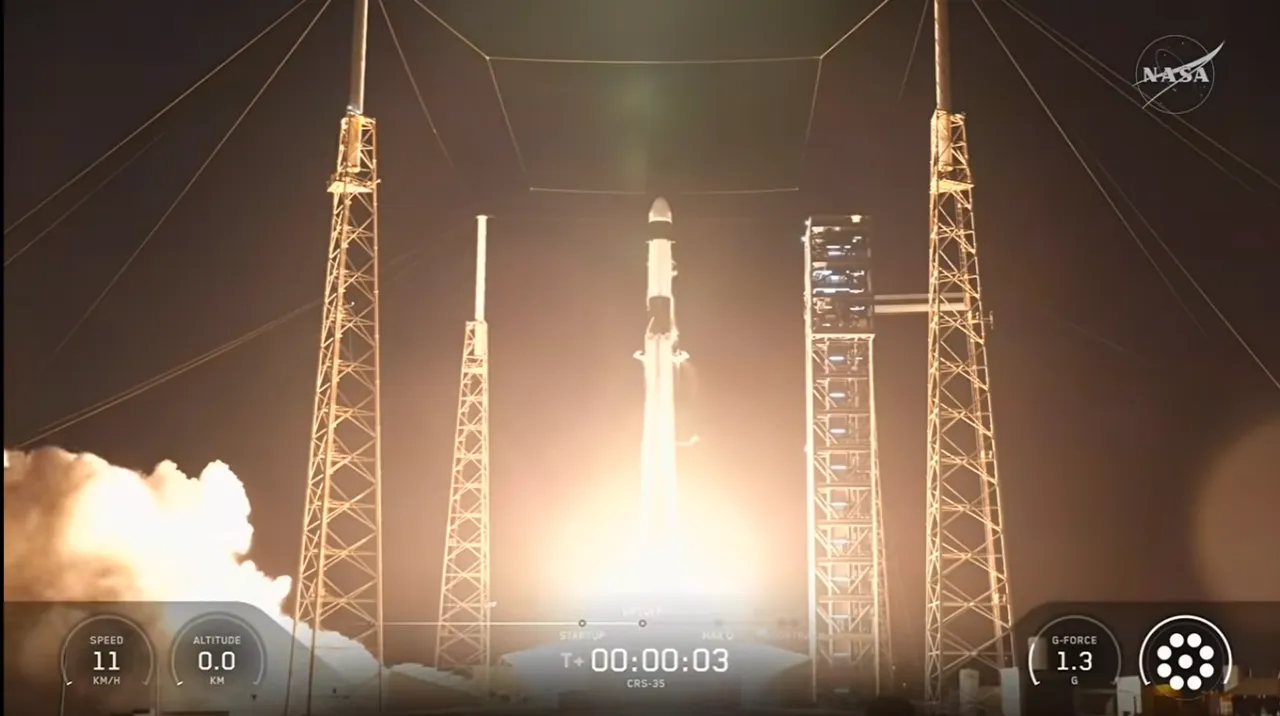
Meanwhile, on Tuesday, SpaceX launched its 35th Commercial Resupply Services mission to the International Space Station from Cape Canaveral Space Force Station.
The mission, known as CRS-35, carried over 6,300 pounds of supplies and hardware, including experiments designed to take advantage of the space station's microgravity environment.
Dragon, the spacecraft carrying the cargo, made its fourth flight on Tuesday, according to SpaceX.
The mission includes hardware to manufacture artificial retinas in microgravity that could help restore vision for patients on Earth and 3D heart tissue models to advance large-scale drug testing on future space missions.
Additionally, lab-grown human brain tissue and a machine designed to print artificial eye retinas layer by layer are among the payloads aboard the Dragon spacecraft.
Autonomous docking with the space-facing port of the ISS Harmony module is scheduled for Thursday.
The launch of CRS-35 was accompanied by a spectacular sight, with a 'space jellyfish' visible in the morning sky over Melbourne, Florida, following the rocket launch.
NASA's Jet Propulsion Laboratory in southern California will manage PRIMA, with Goddard Space Flight Center in Greenbelt, Maryland, and Marshall Space Flight Center in Huntsville, Alabama, serving as partners.
If PRIMA clears its confirmation review, NASA will cap its project cost at $1.2 billion, excluding launch and other non-project costs.
The mission will extend the agency’s fleet survey capabilities and maintain the momentum of flagship missions set by Webb and Roman, according to Shawn Domagal-Goldman, director of NASA’s Astrophysics Division.
What this adds
NASA's PRIMA mission is the first in the new class of astrophysics missions called Probe Explorers within NASA’s Explorers Program.
Background
NASA and SpaceX launched the CRS-35 resupply mission to the International Space Station from Cape Canaveral Space Force Station on Tuesday, October 13, 2026.
NASA has advanced the PRIMA mission into Phase B development and SpaceX launched its 35th resupply mission to the International Space Station on Tuesday, October 13, 2026.
What's confirmed
- ORLANDO, Fla. - NASA and SpaceX launched an early morning resupply mission from Cape Canaveral Space Force Station to the International Space Station on Tuesday.
- CRS-35 is flying under NASA’s second Commercial Resupply Services contract.
- NASA says a SpaceX Falcon 9 rocket launched the company’s 35th Commercial Resupply Services mission to the International Space Station on Tuesday, Oct. 13, 2026, carrying more than 6,300 pounds of supplies and hardware.
What's still developing
- Goddard manages the Explorers Program, NASA’s oldest continuous program, which has launched more than 100 missions since Explorer 1 in 1958.
- Phase B advances preliminary design and technology development, and a confirmation review of technical, programmatic and cost performance will determine whether the mission is ready for Phase C implementation.
- NASA selected PRIMA after evaluating Probe Explorer concept studies on their scientific merit, the feasibility of their cost and schedule plans and their use of technologies that could support future large missions.
- Nicky Fox, associate administrator of NASA’s Science Mission Directorate, noted that PRIMA will help scientists understand how planets, stars, black holes and Earth’s water formed.
- It will be the eighth flight for the booster, which previously supported the KF-01, IMAP, NROL-77, GPS III-9, CRS-34 and NROL-95 missions, along with one Starlink mission.
- NASA has taken the next step in the process of developing a new all-glass telescope for the LISA (Laser Interferometer Space Antenna) mission, a space observatory designed to detect ripples in space-time called gravitational waves.
- On September 23rd, NASA announced its first selection in a new class of astrophysics missions called Probe Explorers.
- The glowing, tentacled cloud that spread across the predawn sky this morning had a scientific mission behind it.