
Home · Science · Oct 7 archive
Chemistry Nobel goes to reactions like those that gave life a hand
Confirmed
In Short: The Royal Swedish Academy of Sciences awarded the 2026 Nobel Prize in Chemistry to Henri Kagan and Kenso Soai for their groundbreaking work on asymmetric organic synthesis, which explains how certain chemical reactions can produce a single mirror image molecule.
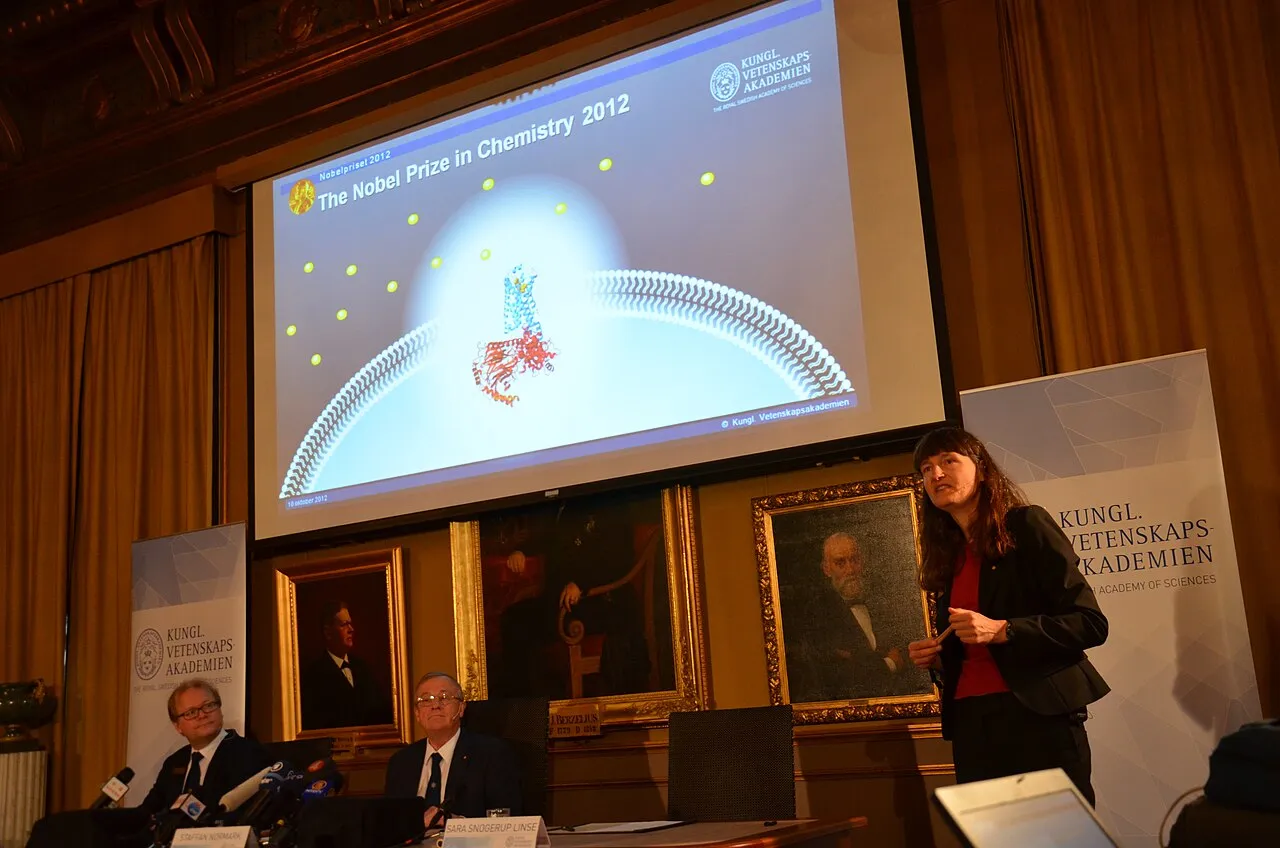
Kagan, from Université Paris-Sud, and Soai, from Tokyo University of Science, were recognized for their discoveries of non-linear effects and autocatalysis in chemical reactions.
Kagan first discovered a new way of manipulating chemical reactions in 1986, while Soai’s work in the 1990s showed how reactions could be biased to produce an excess of one form of a chemical.
Their work has implications for the origins of life, as it helps explain how organisms use only one of the two possible forms of many important molecules.
"Like my hands, they are one another’s mirror image, they look alike but they are not identical," said Heiner Linke, chair of the Nobel committee for chemistry, at a press conference.
"This is probably the coolest experiment in organic chemistry," said Peter Somfai, a member of the Nobel Committee for Chemistry.
"The medicines we have today would not be possible without this chemistry," said Rigoberto Hernandez, president of the American Chemical Society.
"I’m very excited to receive the very nice news," Soai told the committee and journalists by phone.
"Other than life itself, no-one had previously achieved this feat," the committee said in a news release.
"It might be difficult to say that this drug, or that drug, was developed using this," Somfai said.
What this adds
The Nobel Prize in Chemistry follows those for medicine and physics, which were announced earlier this week.
What's confirmed
- Today’s Nobel Prize in Chemistry goes to two individuals, Henri Kagan and Kenso Soai, who discovered chemical reactions could be biased, producing large excesses of one of the two forms of a chemical.
- Henri Kagan, who is at Université Paris-Sud, first discovered a new way of manipulating chemical reactions in 1986.
- The Royal Swedish Academy of Sciences has decided to award the Nobel Prize in Chemistry 2026 to Henri B Kagan from the Université Paris-Sud, France and Kenso Soai from Tokyo University of Science, Japan “for the discovery of non-linear effects and autocatalysis in asymmetric organic synthesis”, according to a press statement.
- Published : October 7, 2026 at 9:05 PM IST The 2026 Nobel Prize in Chemistry awarded to Henri Kagan And Kenso Soai recognises the unraveling of the decades old mystery of producing a particular mirror image molecule in certain chemical reactions.
- “Like my hands, they are one another’s mirror image, they look alike but they are not identical,” Heiner Linke, chair of the Nobel committee for chemistry, said at a press conference.
- Like hands, all amino acids exist as two mirrored variants, but only one of them is found in the proteins in your cells.
- Professor Kagan and Professor Soai found ways to make chemistry pick a side, designing and manipulating reactions to produce the desired mirror-image.
- “This is probably the coolest experiment in organic chemistry,” said Peter Somfai, a member of the Nobel Committee for Chemistry.
- In the 1980s, Prof Kagan’s work showed there might be a way to design reactions to produce one form of a molecule over the other.
- "Henri Kagan and Kenso Soai have provided a solution to a chemical mystery that is over a century old: how homochirality can emerge spontaneously," Heiner Linke, chair of the Nobel Committee for Chemistry, said in a news release.
- “I’m very excited to receive the very nice news,” Soai told the committee and journalists by phone.
- Kagan and Kenso Soai won the Nobel Prize in chemistry Wednesday for untangling mysterious mirror images in molecules, a discovery that has been used to develop countless drugs and transformed modern medicine.
What's still developing
- That poses a bit of a challenge for origin-of-life research, as we’re forced to explain how a world that may have started with an even mix of left- and right-handed chemicals produced organisms that only used one of them.
- He started the reaction with a slight excess of one form of catalyst and found that, after a single round of reactions, the excess in the catalyst had risen to 55 percent.
- If each of those sites is linked to a different chemical, then swapping the chemicals located in any two of them can potentially change the way it’s arranged in 3D space.) This can really matter when it comes to enzymes, which typically latch onto chemicals using binding sites that are sculpted by evolution to fit only that chemical and its close relatives.
- In fact, because of the differences between left- and right-handed chemicals, most of the key enzymes used by organisms will fail to work if they’re presented with chemicals that have the wrong handedness.
- Your hands have all the same components—fingers and thumbs—organized in the same way.
- About a decade later, Tokyo University’s Kenzo Soai was working on reactions where one of the products of the reaction acted as a catalyst to boost the same reaction.
- The phenomenon at the center of this year’s Nobel Prize is called homochirality.
- The chemistry Nobel followed those for medicine and physics announced on Monday and Tuesday Scientists Henri Kagan and Kenso Soai won the 2026 Nobel Prize in Chemistry for solving a long-standing riddle of how to form a single molecular mirror image, a discovery hugely important for pharmaceutical manufacturing, the award-giving body said on Wednesday.
- Professor Robert Mokaya, president of the UK's Royal Society of Chemistry said it was a "powerful example of how fundamental chemistry can underpin solutions to some of the biggest challenges facing society".
- Life is what chemists call homochiral: it uses only one hand of its amino acids and only one hand of the sugars in its DNA, and nobody has fully explained how it got that way.
- When they began to experiment with chemical reactions that can form two mirrored molecules, they always obtained equal proportions of both in their test tubes.
- The other is rarely found in nature, a phenomenon known as "homochirality," the Royal Swedish Academy of Sciences explained.