
Home · Science · Oct 5 archive
Nobel Prizes 2026: What to Know
Confirmed
In Short: The Nobel Prize in Physiology or Medicine 2026 was awarded to Karl Deisseroth, Peter Hegemann, and Georg Nagel for their work in optogenetics.
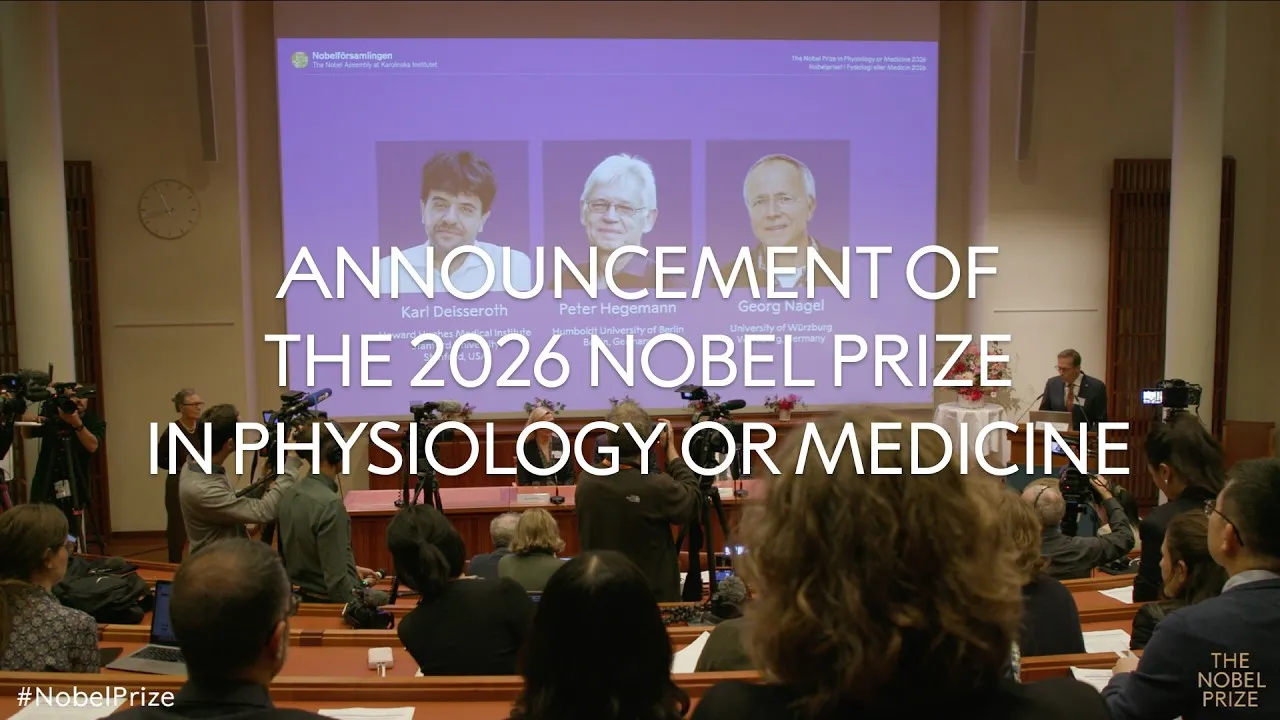
The Nobel Prize in Physiology or Medicine was awarded to three scientists for their groundbreaking work in optogenetics, a technique that allows researchers to control nerve cells using light.
Karl Deisseroth, based at Stanford University, Peter Hegemann at Humboldt University in Berlin, and Georg Nagel at the University of Würzburg in Germany, were jointly honored for their discoveries concerning light-gated ion channels and optogenetics.
According to the Nobel Assembly at Karolinska Institutet, their work laid the foundation for a new era in neuroscience, enabling researchers to discover which nerve cells control different brain functions.
Deisseroth expressed his happiness upon receiving the honor, noting that the trio's work spans the progression from early algal explorations to advanced neuroscience experiments.
Nagel, however, expressed surprise at the award, stating that he believed other medical discoveries had benefited a greater number of people.
The laureates' use of optogenetics will allow researchers to reveal the brain's mysteries and control nerve cells with precision.
The Nobel Prize in Medicine was announced at the Karolinska Institute in Stockholm, marking the start of Nobel week.
The prize amount for each category was increased to $1.22 million, marking the Nobel Prize’s 125th anniversary.
The Nobel Prize in Literature will be announced on October 8, with Can Xue being the favorite at 10/1 according to Ladbrokes.
The Nobel Peace Prize will be awarded on October 12, with 287 candidates nominated this year.
The Nobel Foundation noted that once a Nobel Prize is announced, it cannot be revoked, shared, or transferred to others, emphasizing the finality of the decision.
The Nobel Prize lessons will be available on October 13, providing teachers with a slideshow and speaker's manuscript to introduce students to the Nobel Prize achievements.
What this adds
The Nobel Prize in Medicine was awarded for the first time for optogenetics, a technique that has revolutionized neuroscience research.
The prize amount increase reflects the growing recognition of the Nobel Prizes' importance and the increasing value placed on scientific breakthroughs.
What's confirmed
- The Nobel Prize lessons are published here after the Nobel Prize announcements in October each year.
- Teachers can easily introduce their students to the Nobel Prize awarded achievements using a slideshow with a speaker’s manuscript.
- A lesson about all the six Nobel Prizes will be available here on 13 October.
- This taken on December 6, 2021 shows the medal for the 2021 Nobel Prize for Literature (Abdulrazak Gurnah) on a table at the Swedish Ambassador's residence in London.
- The 2026 winners will be announced between October 5 and 12, starting with the Nobel Prize in Medicine on Monday from 11:30 am (0930 GMT).
- Only 68 of the 633 Nobel prizes awarded since 1901 have been given to women, representing about 10 percent, though the share has been steadily increasing since the early 2020s.
- Here are five things to know about the prizes and their founder.
- Since 1901, five Nobel Peace Prize laureates have been prevented from attending the awards ceremony in Oslo.
- In 2014, 17-year-old Pakistani human rights activist Malala Yousafzai became the youngest winner of a Nobel Prize.
- The Nobel Assembly said Deisseroth is based at Stanford University in California, while Hegemann is at Humboldt University in Berlin and Nagel at the University of Würzburg in Germany.
What's still developing
- AI pioneer and Nobel Prize winner Geoffrey Hinton believes that today’s AI models have become self-aware.
- In the statement, the committee said that while the medal and diploma that a laureate receives with the honor are physical mementos of their achievement, "The prize itself — the honour and recognition — remains inseparably linked to the person or organisation designated as the laureate by the Norwegian Nobel Committee."
- The Nobel Committee did not look to reprimand Machado for her decision, and noted that there is nothing in the statutes of the Nobel Foundation that bars a laureate from giving away their medal, which is cast in 18-carat gold.
- Trump instead said that the U.S. would "run" the country, and stood down when Maduro's second-in-charge was sworn in as the acting president of Venezuela. A White House source later told The Washington Post that Machado accepting the Nobel Peace Prize was the "ultimate sin" in Trump's eyes, claiming, “If she had turned it down and said, ‘I can’t accept it because it’s Donald Trump’s,’ she’d be the president of Venezuela today."
- Machado ultimately said that she "wants to give" Trump her Nobel Peace Prize — an idea that Trump promptly expressed support for.
- Venezuelan opposition leader María Corina Machado, the 2025 Peace Prize laureate, regifted her Nobel medal to Donald Trump at the White House on Jan.
- 16, the Nobel Committee shared a news release titled, "The Nobel Prize and the Laureate Are Inseparable," in which it indirectly addressed Machado's decision to hand over the Peace Prize medal to someone whom the committee initially passed over for the honor.
- "That would be a great honor." Trump's remark prompted the Nobel Committee to release a rare statement the following day, previewing its stance that the honor itself is non-transferrable.
- “The Norwegian Nobel Committee and the Norwegian Nobel Institute receive a number of requests for comments regarding the permanence of a Nobel Peace Prize laureate’s status,” read a Jan.
- "Even if the medal or diploma later comes into someone else’s possession, this does not alter who was awarded the Nobel Peace Prize."
- The brother of Iranian Nobel Peace Prize winner Narges Mohammadi says he fears her life is in imminent danger after she suffered a suspected heart attack in prison in north-western Iran.
- Among the scientists leading the charge is David Baker, who shared the 2024 Nobel Prize in Chemistry for his work in computational protein design.