
Home · World · Oct 4 archive
Research Reveals Freshwater Reservoir Beneath Great Salt Lake
Confirmed
In Short: University of Utah geoscientists have discovered a vast freshwater reservoir beneath the Great Salt Lake, according to new research.
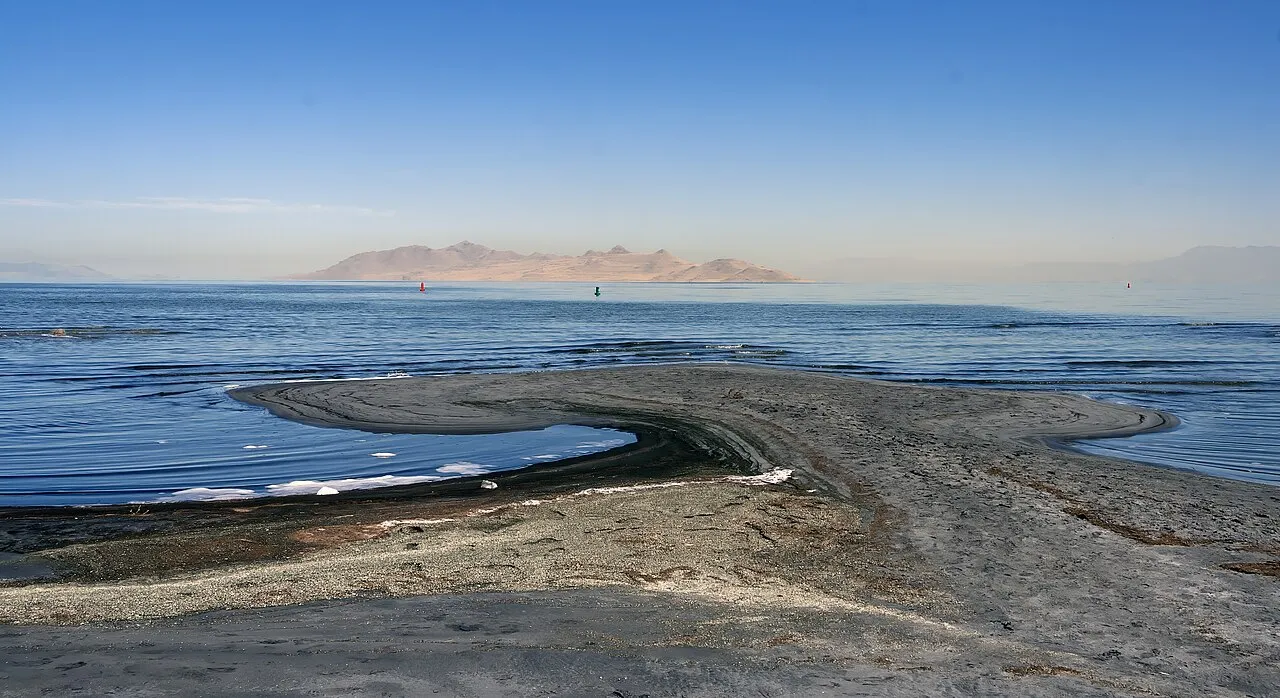
University of Utah geoscientists have discovered a vast freshwater reservoir beneath the Great Salt Lake, according to new research.
The study, published in Scientific Reports, indicates that a significant amount of freshwater may be trapped beneath the lake's surface, potentially reaching depths of up to 2.5 miles.
The research team, using airborne electromagnetic methods, found a continuous freshwater layer stretching from about 330 feet down to 2.5 miles beneath the lake.
According to the study, this freshwater layer is separated from the lake by a saltwater lens, which acts as a barrier trapping the freshwater below.
Professor Bill Johnson, a hydrologist involved in the study, said, “Fresh water exists under the periphery of the lake and maybe even under the lake itself. And we need to better characterize it to understand how we can use it as a resource.”
The team's findings suggest that the freshwater reservoir could be used to mitigate dust issues around the lake. Johnson explained, “We proposed that for higher elevation dust spots, you drop a well and flood the area and douse the dust spot.”
The study also revealed that the age of the water at depth is thousands of years old, possibly left over from the Ice Age.
Researchers noted that the freshwater layer is pressurized and can be detected where it pushes through the saltwater lens to the surface of the playa, forming small islands.
The research is supported by the Utah Department of Natural Resources and the Great Salt Lake Commissioner’s Office.
The Great Salt Lake has dropped by about 22 feet since 1986, driven by drought, climate conditions, and water use.
Zhdanov, a researcher involved in the study, expressed excitement about the findings, saying, “When I first realized that we found this, I was very excited.”
The team plans to continue surveying the entire Great Salt Lake to better understand the extent and potential use of the freshwater reservoir.
What this adds
The research adds to the understanding of the Great Salt Lake's subsurface water dynamics and potential freshwater resources.
The research team's ongoing work will provide a more comprehensive understanding of the freshwater reservoir's extent and potential use.
What's confirmed
- University of Utah geoscientists have discovered a vast freshwater reservoir beneath the Great Salt Lake, according to new research.
- The study, published in Scientific Reports, indicates that a significant amount of freshwater may be trapped beneath the lake's surface, potentially reaching depths of up to 2.5 miles.
- The research team, using airborne electromagnetic methods, found a continuous freshwater layer stretching from about 330 feet down to 2.5 miles beneath the lake.
- According to the study, this freshwater layer is separated from the lake by a saltwater lens, which acts as a barrier trapping the freshwater below.
- The study also revealed that the age of the water at depth is thousands of years old, possibly left over from the Ice Age.
- Researchers noted that the freshwater layer is pressurized and can be detected where it pushes through the saltwater lens to the surface of the playa, forming small islands.
- The research is supported by the Utah Department of Natural Resources and the Great Salt Lake Commissioner’s Office.
- The Great Salt Lake has dropped by about 22 feet since 1986, driven by drought, climate conditions, and water use.
- The team plans to continue surveying the entire Great Salt Lake to better understand the extent and potential use of the freshwater reservoir.
What's still developing
- Together, the team is carrying out a wide-ranging study of this hidden groundwater system.
- Great Salt Lake started taking its present shape about 8,000 years ago as a remnant of the vast freshwater Lake Bonneville that once covered most of northwestern Utah.
- This previously unknown zone is now referred to as the “saltwater lens,” and its discovery is reshaping scientists’ understanding of subsurface water flow in the region.
- They regularly return by airboat or mountain bike to collect data, which now shows these mounds occur where freshwater is pushed under pressure through the saltwater lens to the surface of the playa.
- “The size or radius of the round spot corresponded with the freshness of the groundwater; the bigger the round spot the fresher the water at the center,” Adomako-Mensah said.
- According to a new study, however, this step may be unnecessary for a wide range of tests.
- "Our comprehensive analysis suggests that most routine blood tests are minimally affected by short-term fasting, and fasting beyond 12 hours was not associated with meaningful additional differences for any test examined," the study's authors write.
- To minimize this variability, clinicians began broadly instructing patients to fast for eight to 12 hours before blood sampling – "a practice that originated with lipid and glucose testing," the researchers explain, "but is now applied by default to much broader test panels."
- "These findings suggest that traditional rigid fasting requirements may warrant reconsideration in favor of a more nuanced, analyte-specific approach to pretest preparation." Those rigid fasting rules originally grew from concerns that patients' diets might jeopardize clinical accuracy.
- "provides strong support for accumulating evidence that fasting blood sampling is not necessary."
- As explained in a study, published in Scientific Reports, a helicopter flew back and forth with a device that sent signals into the ground and measured what bounced back.
- That is exactly where dense reeds, known as phragmites, have been growing, one of the first clues that freshwater was present.