
Home · Science · Oct 4 archive
Queen's University Team Heads to NASA Lunabotics Competition
Developing
In Short: The lunabotics competition, held at the University of Central Florida, will see teams from Australia, India, and the US compete alongside the QUB team.
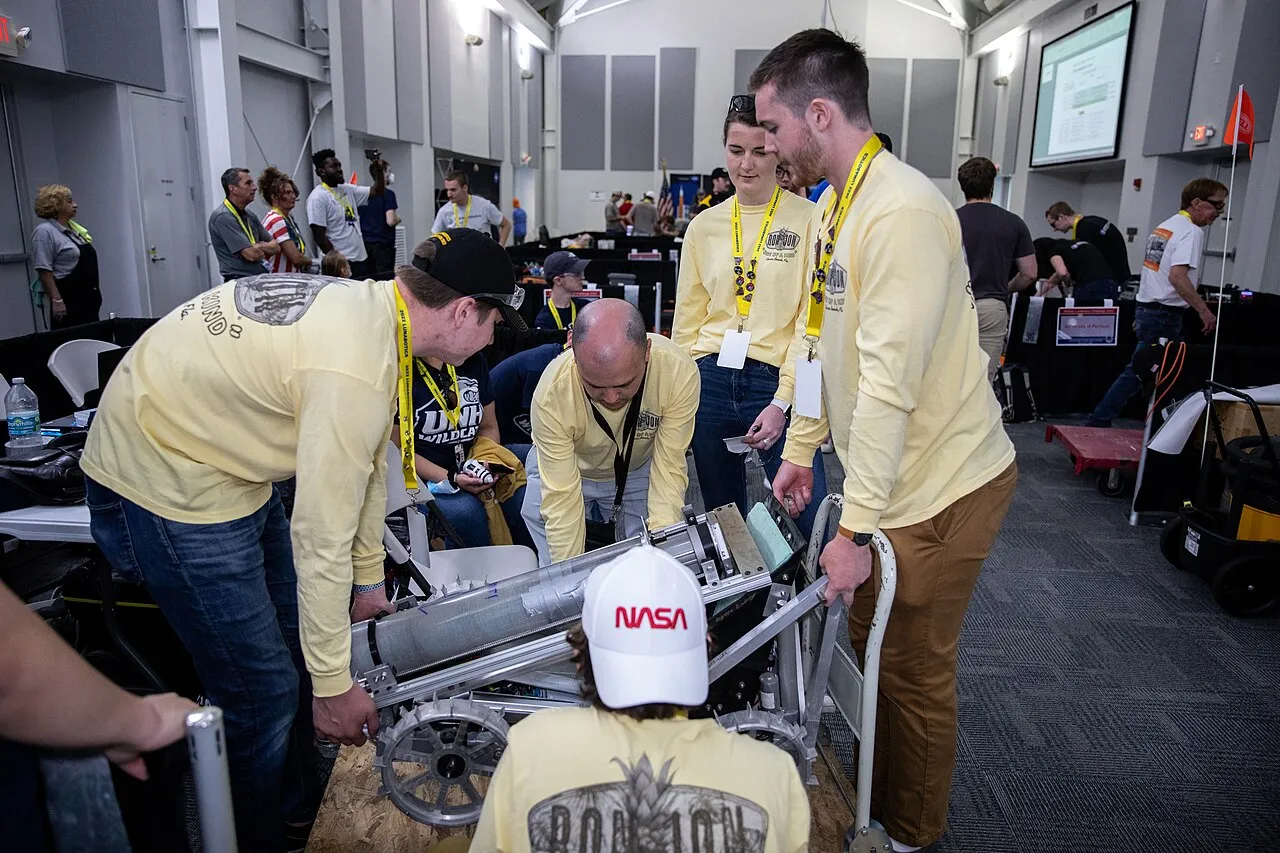
A team from Queen's University Belfast (QUB) is set to compete in NASA's lunabotics challenge in Florida later this month.
Jack Fitzpatrick, a PhD student in mechanical engineering, expressed his excitement about the opportunity to represent Northern Ireland, the UK, and Europe at the international competition.
The QUB team, consisting of 10 students, won a previous competition in Milton Keynes, securing their place at the NASA lunabotics event.
The team is divided into three groups focusing on software, electronics, and mechanical aspects, with each group contributing to the design and construction of a 52 kg aluminium frame robot rover.
Fitzpatrick explained that the robot is designed to autonomously operate on the moon, with the goal of building environments for human habitation.
The QUB team's robot is designed to pick up and deposit sand autonomously, simulating tasks that could be performed on future moon missions.
Caolán Boyle, Head of Robotics at QUB, praised the team's efforts, noting that hundreds of hours have been dedicated to preparing the rover for the competition.
The team sees this as a chance to showcase their skills and build a foundation for future improvements, with the ultimate goal of designing a winning lunar robot.
Fitzpatrick emphasized that while winning is not guaranteed, the experience is invaluable and will help the team improve year after year.
The competition is part of NASA's initiative to foster innovation and talent in the field of lunar robotics, bringing together top university teams from around the world.
What's still developing
- Jack Fitzpatrick, who's studying for a PhD in mechanical engineering, said "it's a great feeling" to have been invited and they're looking forward to the opportunity to take part.
- "We analyse that something is physically strong enough, it's well built enough to survive this environment, it's going to have the traction to drive in this environment," he explained.
- "We got on very well. We ended up winning the competition and had great fun," he said.
- Jack said that being asked to go was a "great feeling" and "a real opportunity to demonstrate everything that you've learned".
- Both of the students said their success was a reflection of both themselves and also the university and the School of Mechanical and Aerospace Engineering.
- Jack explained that there have been several precursor competitions in different countries and this competition takes the top tier of those competitions and brings them together "to really showcase the talent" that there is internationally.
- "We may not win the competition this year but we're building a base upon which we can improve year on year and maybe come back in a few years and really come through with a winning design," he said.
- He said "hundreds of hours have gone into making the rover mission ready for the event".
- Meet the UK's very own LeBron James... but not as you know it 'Our industry is still male dominated, but things are changing' Students eye high-tech plan for Nasa launch watch party Burnham scraps controversial plans to curb jury trials Tories pledge to remove £100,000 childcare 'cliff edge' The Celebrity Traitors connections that might surprise you Are AI models the next big danger for body image?
- They'll be competing at the University of Central Florida against university teams from Australia, India and the US.
- Jamie was the software team lead for this project.
- "It'll pick up the sand and then deposit it at another location, and it's meant to do this all by itself."