
Home · Science · Oct 1 archive
Help Overlap Zoo Reveal Cosmic Dust
Confirmed
In Short: Karyu's study in Nature Astronomy reveals Venus' haze forms from cosmic dust, while NASA's Overlap Zoo project invites volunteers to classify overlapping galaxies.
Karyu's study in Nature Astronomy reveals that Venus' lower haze layer is sustained by cosmic dust particles, rather than volcanic or surface dust, as previously thought.
The process begins when cosmic dust, akin to 'shooting stars,' enters Venus' atmosphere and interacts with sulfuric acid to form haze particles.
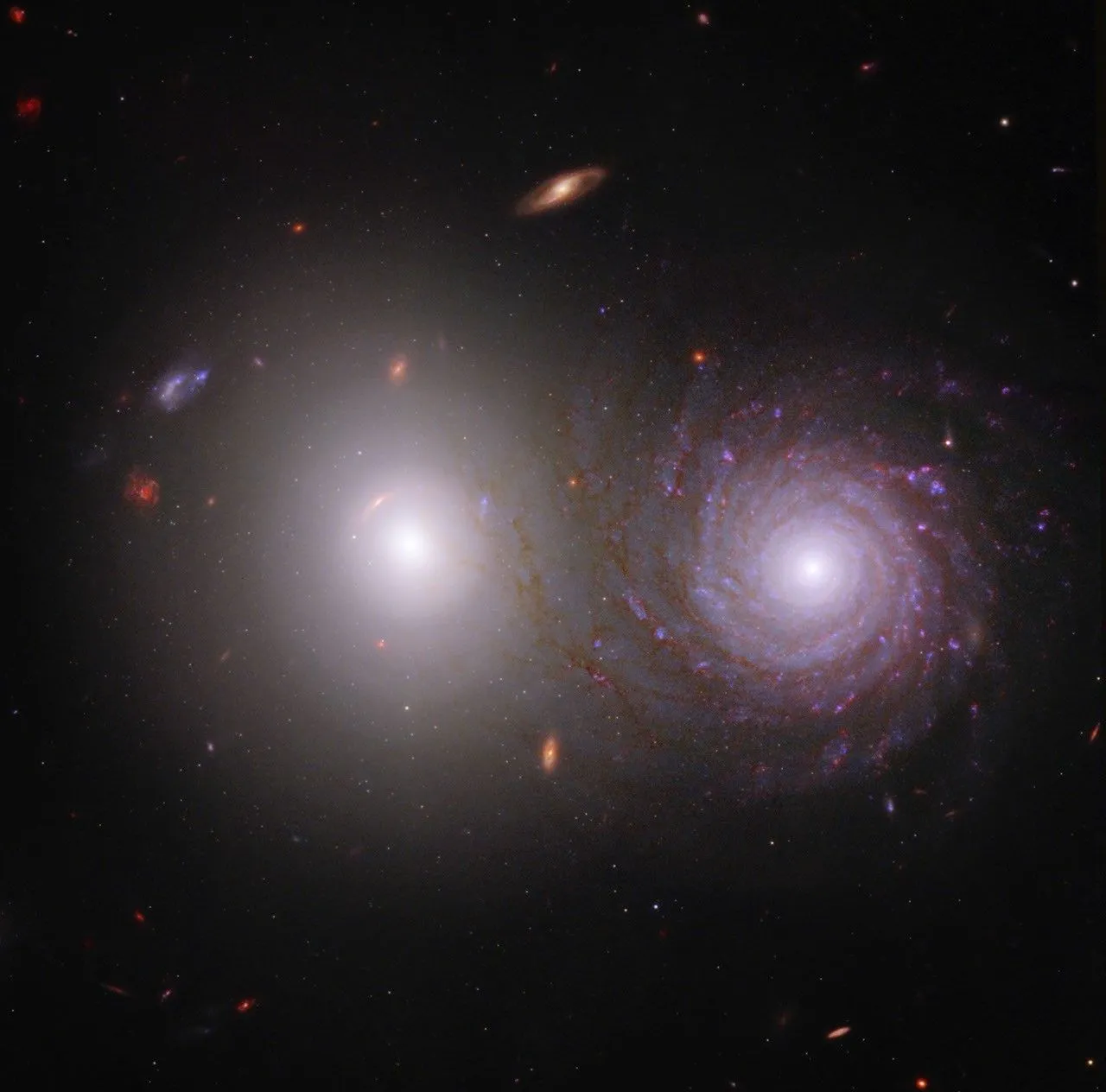
NASA's Overlap Zoo project is now seeking volunteers to help classify overlapping galaxies, a rare cosmic occurrence.
Overlap Zoo builds on the success of the Galaxy Zoo project, where volunteers have already identified images containing possible overlapping galaxies.
Astronomers use these rare alignments to study the distribution of dust within galaxies, which can help refine estimates of distances to faraway objects.
By studying the dark silhouettes created when a background galaxy shines through a nearer galaxy, astronomers can map dust distribution.
Ali Alobaidly won the coveted Royal Observatory Greenwich award for his image of the Shark Nebula, titled 'The Quiet Predator,' capturing the poetic connection between cosmic wonders and his heritage.
Photos of a new NASA-made material, taken with a microscope, reveal a colorful, kaleidoscope-like crystal structure that could be used for future space manufacturing.
What this adds
The Overlap Zoo project aims to classify overlapping galaxies to better understand cosmic dust distribution.
What's confirmed
- Karyu's study in Nature Astronomy reveals that Venus' lower haze layer is sustained by cosmic dust particles, rather than volcanic or surface dust, as previously thought.
- The process begins when cosmic dust, akin to 'shooting stars,' enters Venus' atmosphere and interacts with sulfuric acid to form haze particles.
- NASA's Overlap Zoo project is now seeking volunteers to help classify overlapping galaxies, a rare cosmic occurrence.
- Overlap Zoo builds on the success of the Galaxy Zoo project, where volunteers have already identified images containing possible overlapping galaxies.
- Astronomers use these rare alignments to study the distribution of dust within galaxies, which can help refine estimates of distances to faraway objects.
- By studying the dark silhouettes created when a background galaxy shines through a nearer galaxy, astronomers can map dust distribution.
- Ali Alobaidly won the coveted Royal Observatory Greenwich award for his image of the Shark Nebula, titled 'The Quiet Predator,' capturing the poetic connection between cosmic wonders and his heritage.
- Photos of a new NASA-made material, taken with a microscope, reveal a colorful, kaleidoscope-like crystal structure that could be used for future space manufacturing.
What's still developing
- “The continuous influx of cosmic dust is sufficient to sustain this lower haze layer with the particle size distribution observed by the entry probes,” Karyu said in a study published in Nature Astronomy.
- Karyu found that even if there were much larger influxes of volcanic or surface dust on Venus, the particles would still not be able to interact with the atmosphere’s sulfur in the right way to form the haze.
- Instead of simply accumulating dust, Venus’ haze forms through a process that starts similarly to how clouds form on Earth.
- A physical model show that iron dust and sulfuric acid create the right properties.
- “These haze particles of cosmic origin act as efficient condensation nuclei, promoting cloud formation in the main cloud deck even far from their initial source.” Previous speculation suggested the haze formed from volcanic ash.
- Overlap Zoo is asking for your help with the search.
- "As new and better observations of galaxies continue to multiply, it is becoming incredibly difficult for astronomers to classify every candidate galaxy pair," said Trevor Butrum, Overlap Zoo project lead and graduate student.
- Head over to Overlap Zoo and start classifying galaxies today.
- Galaxies, vast collections of billions of stars, gas, and dust held together by gravity, are scattered across the immensity of space.
- But every so often, a coincidence occurs: Two galaxies line up from our point of view on Earth (or from a space telescope) and appear to overlap in the sky.
- The backlit dust creates dark silhouettes, like shadows on a screen.
- However, before we can study galaxy pairs and their dust, we first need to find them!