
Home · Business · Sep 29 archive
Meta Expands Muse AI to Help Small Businesses
Confirmed
In Short: Meta Platforms Inc. is expanding its Muse AI agent to support small businesses, integrating it with a range of software tools for payments, accounting, marketing, and workplace collaboration.
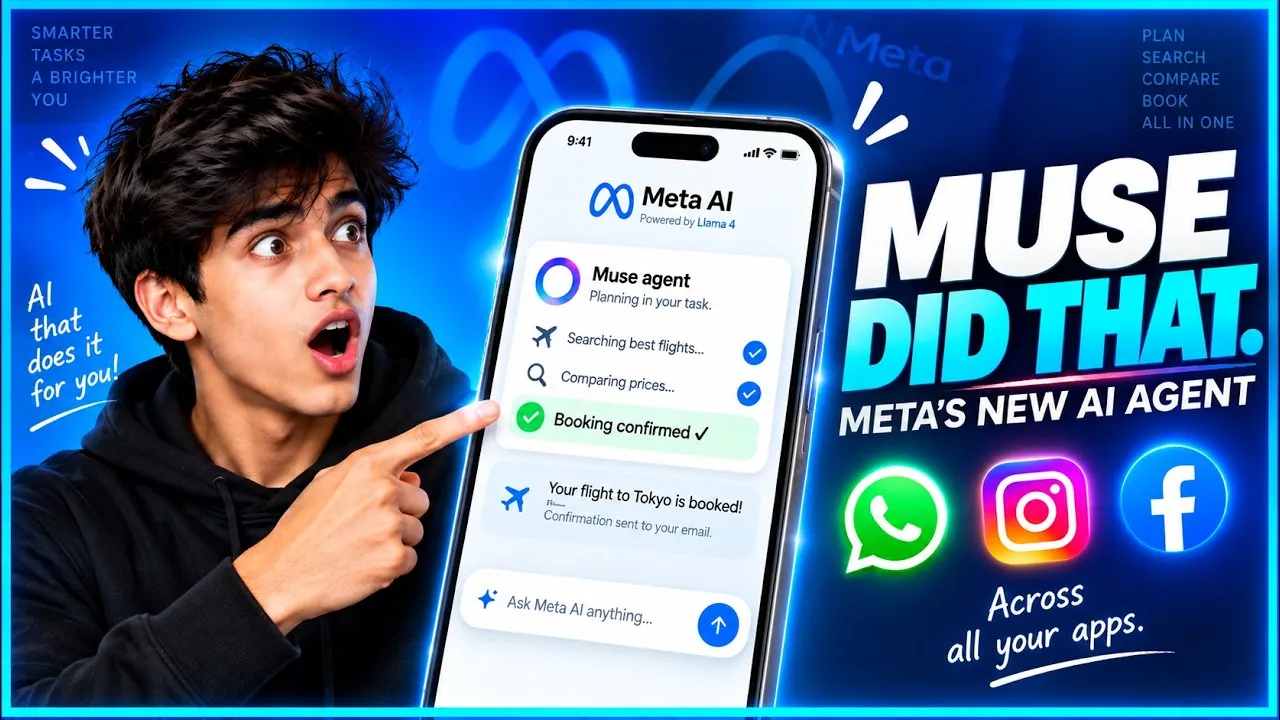
With this expansion, Muse can now work toward broader business goals across connected services, reducing the need for owners to handle each task separately.
Meta said Muse begins with an understanding of the business based on connected tools, allowing owners to give it goals such as finding new customers or managing daily operations.
Once connected to a company’s tools, Muse can use information available across those services as context for its work.
Muse for Small Business supports 15 third-party integrations, including Shopify, Stripe, Intuit QuickBooks, Klaviyo, Canva, Figma, Slack, Asana, and Notion.
The new version of Muse can help small businesses with tasks like putting together a growth plan for the next year after analyzing sales and social media data along with business goals.
Meta is also drawing a clear line around what the agent can do on its own. Muse can work toward a task using connected business information, but outward-facing actions such as publishing content, sending communications, or spending money still require the owner’s approval.
Muse for Small Business is free for most users, with subscription plans available for those seeking additional features.
Tom Mulholland, owner of Mulholland Grocery in Malvern, Iowa, said Muse is taking on tasks outside his core expertise.
Analysts suggest that Muse could become the most widely used consumer AI application since ChatGPT.
The company is positioning Muse as a solution that connects Instagram professional accounts, Facebook Pages, and Meta ad accounts with tools including Asana, Box, Dropbox, Figma, Klaviyo, Notion, Slack, and Zoom.
Muse’s specialized approach to small business pain points, such as automated customer responses, inventory tracking, social media management, and basic financial operations, sets it apart from broader enterprise solutions like Google Workspace or Microsoft 365.
Background
Meta's new AI assistant, Muse, is drawing both praise and criticism for its capabilities and data collection practices.
What's confirmed
- Meta Platforms Inc. ( META ) is pushing its Muse AI agent beyond personal assistance and into day-to-day small-business operations, giving it access to the software companies already use for payments, accounting, commerce, marketing and workplace collaboration.
- With this expansion, Meta is positioning Muse to work toward broader business goals across those connected services rather than requiring owners to handle each task separately.
- Meta said Muse begins with an understanding of the business based on those connected tools, reducing the need for owners to repeatedly supply the same information.
- A business owner could, for example, give Muse a goal such as finding new customers or helping run the business.
- Once connected to the company’s tools, Muse can use information already available across those services as context for its work.
- Muse for Small Business supports 15 third-party integrations, including Shopify (SHOP) and Stripe for commerce and payments, Intuit QuickBooks (INTU) for accounting, Klaviyo for marketing, Canva and Figma (FIG) for design and Slack, Asana and Notion for workplace tasks.
- That gives Muse a broader operating view across the different services a small company may already rely on.
- Meta is also drawing a clear line around what the agent can do on its own.
- That means Muse can work toward a task using connected business information, but outward-facing actions such as publishing content, sending communications or spending money still require the owner to sign off.
- Meta introduced Muse earlier this month as a personal AI agent designed to work toward longer-term goals rather than simply respond to individual prompts.
- Meta launches Muse for small businesses, pushing beyond the consumer AI market Meta Platforms is reportedly expanding its AI agent Muse to small businesses by implementing software integrations with tools such as Shopify, QuickBooks, Stripe and Canva-a significant move to help them run their businesses and find new customers as the Facebook-parent reduces its reliance on ad revenue.
What's still developing
- The company said that Muse is now capable of being integrated or unified with a company’s brand storefront, books and customer records.
- Muse launched this month is a personal AI agent designed to complete crucial tasks including shopping, travel booking, emailing and proxy payments.
- Muse will not publish content or send messages or make purchases without a user’s approval.
- Meta Launches Muse for Small Business, Signals Enterprise Push Meta expands AI agent strategy with business-focused Muse variant targeting SMBs PUBLISHED: Tue, Sep 29, 2026, 12:07 PM UTC | UPDATED: Tue, Sep 29, 2026, 12:07 PM UTC Meta just made its boldest move yet into enterprise AI, launching Muse for Small Business as CEO Mark Zuckerberg pivots beyond consumer markets.
- What makes this launch particularly interesting is how Meta is positioning itself.
- Instead of competing directly with established enterprise sales channels, the company is leveraging its existing small business advertising relationships.
- Salesforce has been pushing Einstein AI, but their solutions often feel overbuilt for small businesses.
- Google recently announced enhanced small business features for Bard, while Microsoft is reportedly accelerating Copilot integration across its SMB-focused Office plans.
- The specialized AI agent builds on the success of Meta's personal Muse assistant, targeting the massive small business segment that competitors like Google and Microsoft have been aggressively courting.
- This marks Meta's most direct challenge to established enterprise players in the AI automation space.
- The company's launch of Muse for Small Business represents more than just another product rollout - it's a direct assault on the enterprise market that Google and Microsoft have dominated for years.
- Meta said Muse for Small Business is free for most uses, with paid tiers for heavier users — mirroring the model of the standalone Muse app, which offers a no-cost entry point subject to usage caps.
Sources
- Asianet Newsablelink
- Financial-News.co.uklink
- Fox Businesslink
- International Business Timeslink
- Investopedialink
- Iphoneincanadalink
- Stocktwitslink
- Tech Editionlink
- TechCrunchlink
- Techgenyzlink
- The Economic Timeslink
- The News Internationallink
- The Tech Buzzlink
- Thetrumpetlink
- Windowsreportlink
- qz.comlink
- Try AI With Me — video link