
Home · Faith · Sep 28 archive
Pope Leo XIV Urges Ethical AI Amid Human Dignity Concerns
Confirmed
In Short: Pope Leo XIV’s encyclical and his visit to UNESCO highlight his ongoing concern about the ethical implications of technological advancements, particularly AI, on human dignity.
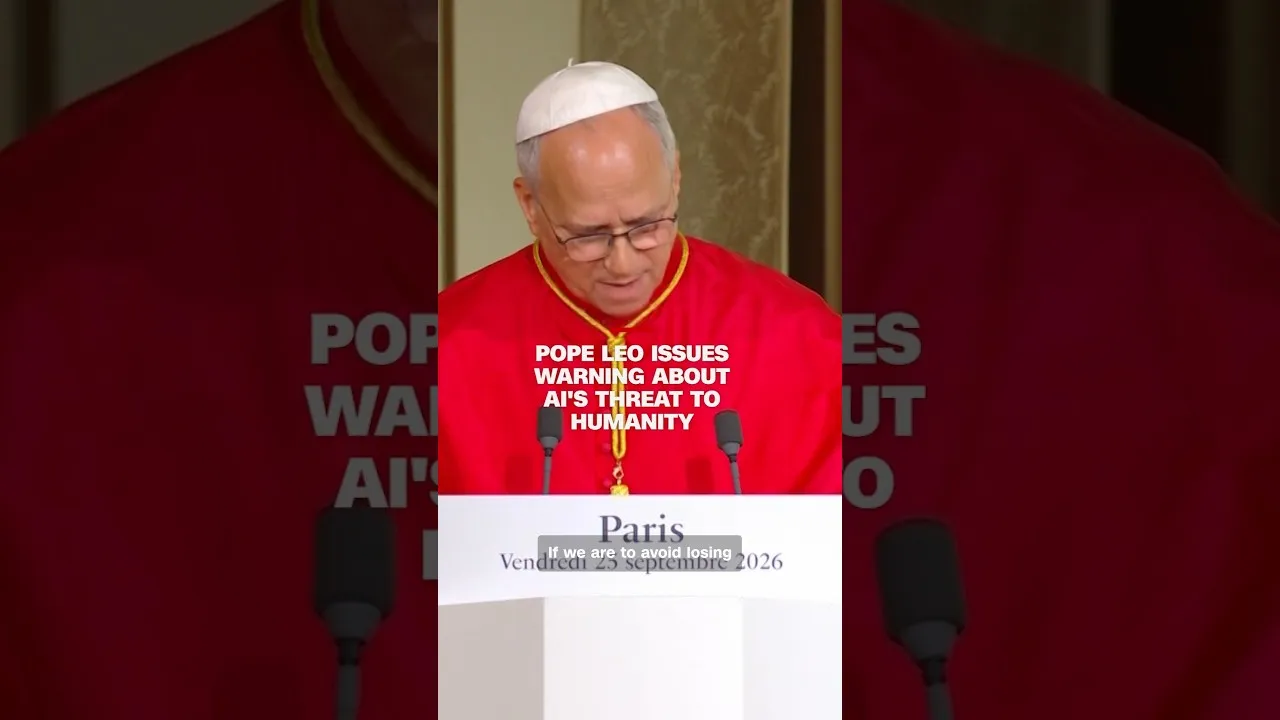
Pope Leo XIV urged world leaders to address the ethical implications of artificial intelligence (AI) during his visit to UNESCO in Paris on September 25, 2026. The pope emphasized the need for responsible technological progress and ethical safeguards in the face of rapid scientific and digital developments.
In a speech at the Robert Schuman Conference Center in Metz, France, Pope Leo XIV called on Europe to resist a return to nationalism and conflict, urging leaders to recommit to cooperation, dialogue, and peace. He highlighted the symbolic importance of Metz, a city that changed hands between France and Germany through two world wars, as a testament to reconciliation.
Pope Leo XIV also addressed the broader question of what it means to be human, urging the assembly to explore the fundamental question that challenges every culture, knowledge, art, and religion. His visit to UNESCO included a forum earlier in the day with educators, cultural leaders, and youth representatives.
Upon his arrival at UNESCO, Pope Leo XIV was greeted by UNESCO representatives and had a brief private meeting with UNESCO’s director-general, Audrey Azoulay. The pope and Azoulay were handed green watering cans and watered the olive tree before heading to the main hall, where the pontiff was greeted with cheers and a standing ovation.
Pope Leo XIV’s visit to France, which includes stops in Paris, Lourdes, and Metz, aims to address peace, Europe, faith, and human dignity. The pope’s message underscores the need for responsible technological progress and ethical safeguards in the face of rapid scientific and digital developments.
In his May encyclical, Magnifica Humanitas, Pope Leo XIV warned that artificial systems should not be entrusted with lethal or irreversible decisions and argued that technology must remain subject to human moral judgment. He criticized the logic of nuclear deterrence, saying it risked fueling a new arms race, and urged world leaders not to accept war as inevitable.
Pope Leo XIV also warned of the danger that humanity could lose itself in a 'paradise of machines,' as church bells rang and thousands gathered to welcome him to France amid growing global concerns over the risks associated with artificial intelligence. He emphasized the urgent need for education in ethical discernment to ensure that humans do not lose their humanity amid technological advancements.
The pope’s visit to France also includes a meeting with seven French survivors of clergy sexual abuse, as critics demand further action. Pope Leo XIV’s message to political leaders is a logical extension of the Christian obligation to turn toward and welcome one’s neighbor.
Pope Leo XIV’s encyclical and his visit to UNESCO highlight his ongoing concern about the ethical implications of technological advancements, particularly AI, on human dignity. He argued that technology is not inherently hostile to human flourishing, but neither is it neutral, and ethical slogans mean little if the rules are written by a narrow elite with a vested interest in the outcome.
What this adds
Pope Leo XIV’s visit to UNESCO highlights his ongoing concern about the ethical implications of technological advancements, particularly AI, on human dignity. This visit builds on his previous calls for ethical AI governance in his first encyclical, which argues that technology must be governed by law, oversight, and human judgment rather than left to market forces or military competition.
Background
Pope Leo XIV urged world leaders to address the ethical implications of artificial intelligence (AI) during his visit to UNESCO in Paris on September 25, 2026.
Pope Leo XIV warned that human dignity is being overlooked in the name of efficiency and productivity in the era of AI during a visit to UNESCO.
What's confirmed
- Pope Leo XIV also criticized the logic of nuclear deterrence, saying it risked fueling a new arms race, and urged world leaders not to accept war as inevitable.
- In his May encyclical, Magnifica Humanitas, Pope Leo XIV warned that artificial systems should not be entrusted with lethal or irreversible decisions and argued that technology must remain subject to human moral judgment.
- "If we want to avoid losing our humanity amid a paradise of machines that are invading and shaping our daily lives, we urgently need education in ethical discernment," Leo XIV said after President Emmanuel Macron welcomed him at the presidential palace at the start of his four-day visit to France.
- Leo called on political leaders not to become indifferent to suffering in the Middle East, where conflict involving Iran and Lebanon has caused widespread humanitarian concern.
- "We cannot remain indifferent to such suffering that wounds human dignity and cries out to God for justice," Leo said.
- "If we are to avoid losing our humanity amid a 'paradise of machines' invading and conditioning our daily lives, there is an urgent need for education in ethical discernment and the capacity to acknowledge the moral good," he said.
- He said the protection of life was the foundation of all other human rights and expressed concern about technological and scientific developments that could turn human life into a commercial enterprise.
- "I am concerned at times by those trends in society that risk turning science and technology into profit-driven ventures promoting genetic manipulation, surrogacy, the trade in human organs or the possibility of arranging one's own death," he said.
- The pope is seeking to speak to a country with deep Christian roots but where Catholic influence over public policy and social issues has declined under France's strong tradition of secularism.
- Pope Leo XIV opened his four-day visit to France on Friday with a broad appeal for peace, human dignity and responsible technological progress, urging world leaders not to accept war as inevitable while warning that artificial intelligence and other advances could erode humanity if left without ethical safeguards.
- Speaking at the Elysee Palace after arriving in Paris, the U.S.-born pope addressed a range of issues, including the wars in the Middle East, nuclear weapons, assisted dying, artificial intelligence and the role of journalism.
What's still developing
- “Today, sadly, war has returned, even to Europe: a new ‘senseless slaughter,’ claiming countless civilian lives every day,” the pope said in a speech to French President Emmanuel Macron and political and clerical leaders at the Robert Schuman Conference Center Sept. 28.
- More than seven decades later, Pope Leo argued that the institutions created out of that experience remain an antidote to the desire for domination.
- Today, people “boast of lies and deceit,” the pope said, but Europe’s experience has demonstrated that divergent interests do not have to end in conflict.
- In an address to Pope Leo in Metz, French President Emmanuel Macron described the region of Lorraine as a land “wounded by history, disputed, conquered and reconquered,” but also the place where Franco-German reconciliation was built and became a cornerstone of European integration.
- But Pope Leo’s appeal for reconciliation in Metz extended beyond relations between governments.
- El-Enany, UNESCO’s director-general, welcomed Pope Leo XIV, calling his visit “a truly historic moment” as it was the first visit by a pontiff in 46 years.
- Tech leaders said AI is rapidly reshaping society and the Church, offering powerful tools for ministry while also requiring firm ethical boundaries, human‑centered leadership, and faith‑guided discernment to ensure the technology strengthens human dignity.
- Catholic leaders discussed rising benefits and concerns of technology and how faith and ethics apply when using artificial intelligence.
- He added that despite real concerns about job loss and disruption, he remains optimistic because humans are “unbelievably ingenious” and made to solve problems.
- "Today, at last, I will see the pope," said the retiree from the southwestern city of La Rochelle, who had come early with her folding chair to secure a good view.
- Lydie Mouradian, 74, was hoping to catch a glimpse of the pope when the popemobile drew closer to Notre Dame.
- AI safety concerns are intensifying as Pope Leo XIV urges human control over AI, while industry giants pursue self-regulation amid warnings about potentially catastrophic risks.