
Home · Science · Sep 24 archive
NASA's Perseverance Reveals Complex Water History in Jezero Crater
Confirmed
In Short: NASA's Perseverance rover has uncovered a complex history of water activity in the Margin Unit of Jezero Crater on Mars, challenging previous hypotheses.
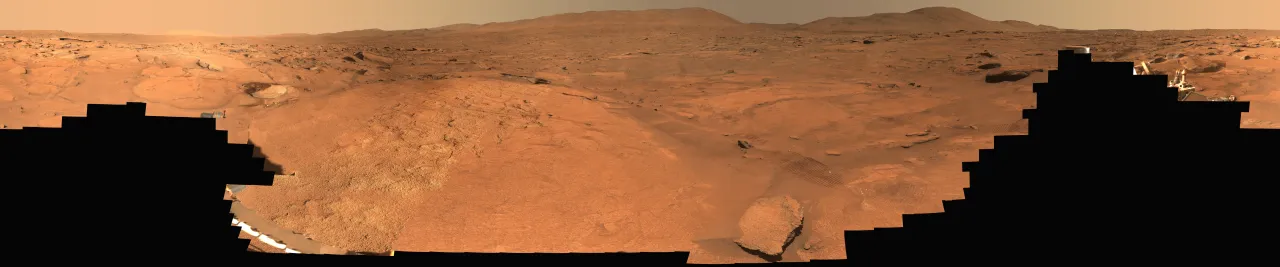
NASA's Perseverance rover has uncovered a complex history of water activity in the Margin Unit of Jezero Crater on Mars, challenging previous hypotheses.
When the rover reached the inner edge of Jezero Crater in September 2023, scientists were surprised to find that the rocks in the Margin Unit had interacted with water on at least three separate occasions.
The rover's SuperCam instrument analyzed more than 185 bedrock targets, revealing that the rocks were originally crystalline and rich in olivine, with almost no signs of water interaction at higher elevations.
However, at lower elevations, the rocks showed signs of interaction with water, including carbonate ridges in fractures and mineral veins containing calcium sulfate and fluorite.
The first episode involved carbon-dioxide-rich groundwater reacting with olivine, the second may have been related to a lake that once existed in the crater, and the third was a heated underground-water event.
Candice Bedford, a research scientist at Purdue University and lead author of the study, noted, “Before we arrived at the Margin Unit, the main hypothesis was that the carbonate seen from orbit formed from interaction with the lake that existed in Jezero Crater.”
Bedford added, “But now we know that this location became a sort of crossroads for aqueous systems.”
The findings suggest that the Margin Unit preserves an intricate record of water activity on early Mars, providing new insights into the planet's geological history.
The rover's discoveries challenge previous assumptions and highlight the complexity of water systems on ancient Mars.
NASA's Jet Propulsion Laboratory, managed by Caltech in Pasadena, built and operates the Perseverance rover.
The rover landed in Jezero Crater in February 2021 to investigate the geological record and search for signs of ancient life.
What's confirmed
- In fact, these rocks showed signs of having interacted with water on at least three separate occasions, with each encounter further altering their chemistry and appearance.
- “Before we arrived at the Margin Unit, the main hypothesis — derived from orbital observations — was that the carbonate seen from orbit formed from interaction with the lake that existed in Jezero Crater,” said Candice Bedford, a research scientist at Purdue University in West Lafayette, Indiana, and the study’s lead author.
- “If there is one thing I have learned after 10 years working with Mars rovers, it is that Mars constantly throws surprises at you,” said Bedford.
- In this case, they preserved an astonishingly complex record of water activity on early Mars.
- “But now we know that this location became a sort of crossroads for aqueous systems.” Using its SuperCam instrument, Perseverance has analyzed more than 185 bedrock targets across the unit.
What's still developing
- The scientists were especially intrigued by strong signals of carbonate minerals detected by Mars orbiters.
- A geologic area on Mars that scientists expected to hold lakeshore sediment instead holds igneous rock that interacted with water on at least three separate occasions, according to a study published Monday that draws on data from NASA’s Perseverance rover.
- The team can determine the order of the water episodes but not their age, NASA said.
- Using data collected by NASA’s Perseverance rover, planetary scientists have revealed that a geologically puzzling formation in Jezero crater experienced multiple distinct episodes of water-related alteration, deepening its significance as a target in the search for ancient signs of life on Mars.
- Below what they believe was once the second terrace level of the ancient Jezero lake, the scientists identified evidence of three separate fluid-driven alteration events.
- Jezero crater is 45 km (28 miles) in diameter and is situated on the northwestern side of the 1,200 km (746-mile) Isidis impact basin, and northeast of the Syrtis Major volcanic province near a region known as Nilli Fossae.
- Using chemical and imaging data gathered by Perseverance’s SuperCam instrument across more than 185 rock targets, they determined that the unit originated as a crystalline, olivine-rich igneous rock, likely formed by slow cooling deep within a magma body.
- Later, exposure to lake water or shifting groundwater chemistry remobilized that carbonate and precipitated silica into pore spaces within the rock.
- The minerals Perseverance detected with its SuperCam, which determines the mineralogy of geologic features based on reflected light, preserved a very complex record of water activity in the region when Mars was young.
- In Mars' Jezero Crater, a geologic area known as the “Margin Unit” stretches along the shoreline of a lake that filled the region billions of years ago.
- At high elevations of about 2350 m (~7700 ft), the rock had the texture and chemistry of slow-cooled, olivine-rich rock without significant water exposure.
- Credit: NASA/JPL-Caltech/University of Arizona/JR/VRVis This was especially near features like Neretva Vallis and the Western fan, the dried-up river channel that once carried water into Jezero Crater and the western part of the massive sedimentary deposits contained within (respectively).