
Home · Science · Sep 23 archive
Solar Sails Could Deflect Asteroids at 100 km/s
Confirmed
In Short: Researchers propose using solar sails to deflect asteroids by hitting them head-on at high speeds.
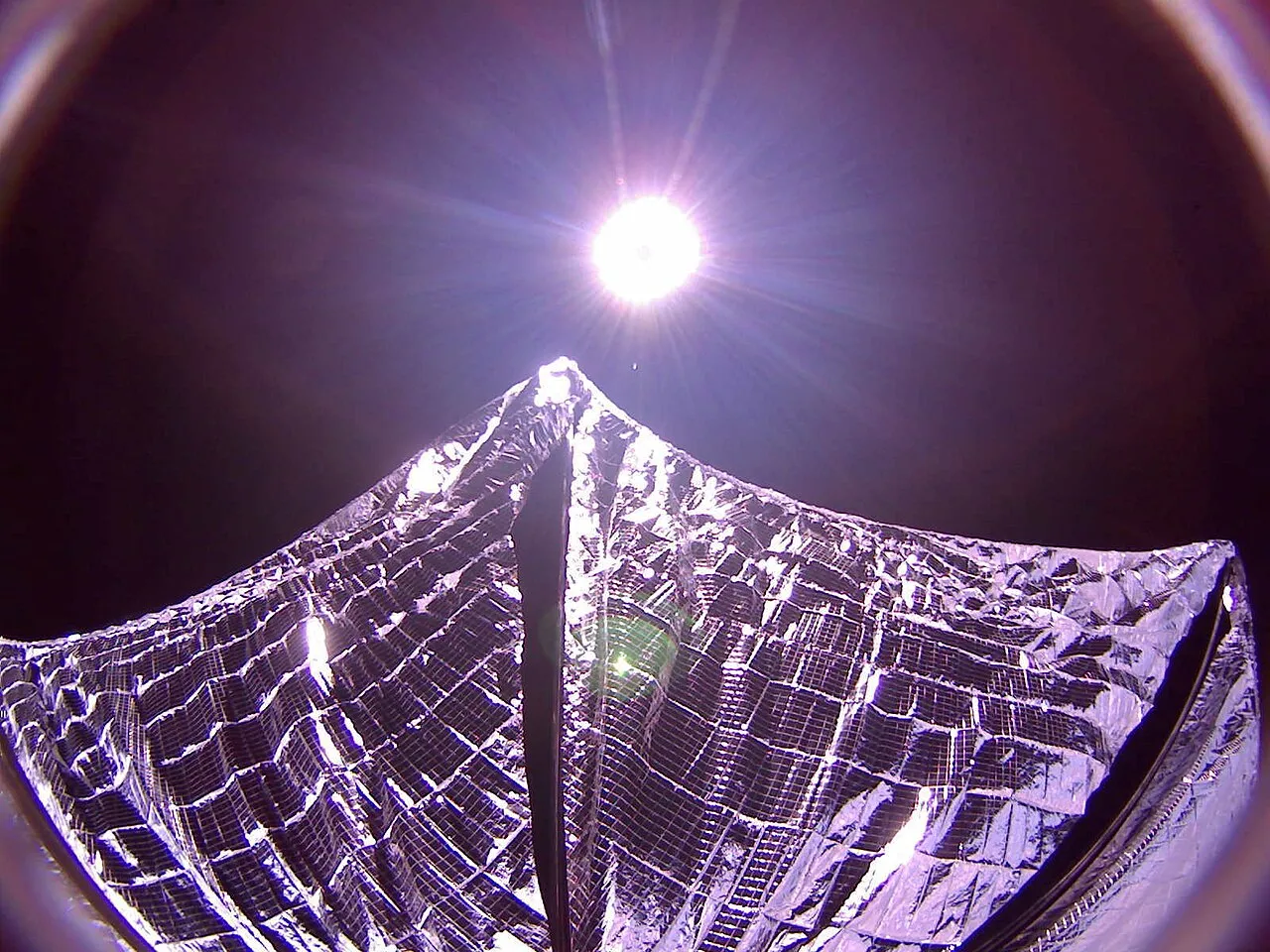
Researchers at Beihang University have proposed a new method to deflect potentially hazardous asteroids using solar sails.
According to a new paper, an impactor using a solar sail can approach an asteroid from the opposite direction, hitting it at around 100 km/s.
In the 1990s, Italian engineer Giancarlo Vulpetti developed the concept of a H-reversal trajectory, which allows a solar sail to start orbiting backwards.
The researchers simulated several types of solar sail configurations and found that reflection-type diffractive sails are the most effective for this trajectory.
These sails do not fall into the Sun or get pushed out of the solar system, making them ideal for asteroid deflection.
While DART successfully moved a small asteroid using a kinetic impactor, researchers are now exploring more powerful methods to deal with larger threats.
Asteroids do not come with warning labels, making it crucial to develop effective deflection techniques.
The success of DART proves that kinetic impactors can be viable, but the new solar sail method could offer a more powerful solution.
Meanwhile, NASA's Lunar Reconnaissance Orbiter (LRO) has detected the largest newly formed crater ever found in the solar system, named McGetchin.
This crater, about 728 feet wide and 141 feet deep, was formed by an asteroid or comet fragment the size of a three- to six-story building between April 11 and May 22, 2024.
What this adds
The new solar sail method could significantly enhance our ability to deflect asteroids, but further testing and development are needed.
What's confirmed
- According to the website, the crater, named McGetchin, is about 728 feet wide and 141 feet deep, making it the largest newly formed impact crater ever identified in the solar system.
- Scientists estimate that it formed sometime between April 11 and May 22, 2024, when a comet or asteroid roughly the size of a three- to six-storey building struck the Moon’s eastern edge.
What's still developing
- DART smashed into Dimorphos, its target asteroid at about 6 km/s - a respectable speed, but limited by the fact that it was coming from the same direction.
- According to the new paper, an impactor using a solar sail can come at an approaching asteroid from the opposite direction - akin to a wrong-way highway driver - and smash into its target at around 100 km/s - imparting something like 230 times the force per kilogram of impactor mass than the DART test did.
- In their simulations, only that type didn’t either fall into the Sun or get launched onto a trajectory where it was pushed out of the solar system entirely.
- Deflecting an asteroid using an impactor comes down to one simple factor - energy.
- Through the comparison of photographs, researchers were able to prove that this was a result of a massive impact event, making it the largest new crater ever discovered in the solar system.
- The finding represents the solar system's biggest known impact crater carved out in recent times.
- A study published Wednesday in the journal Science Advances determined it was the largest new crater ever discovered in the solar system.
- It is believed to have been created in the spring of 2024 from a comet or asteroid colliding with the Moon, with researchers describing the object that caused it to be the size of a building three-to-six stories high.
- This discovery marks McGetchin as the largest known newly formed impact crater in the entire solar system, an event that is expected to occur on the moon roughly once every century.
- “Our study suggests that comets may be responsible for transporting water to the inner parts of the planetary system, where planets can form, in the same way as in the early Solar System,” lead author Novais said in a press release.
- They found that gas giants in the system could perturb distant icy solar system objects and bring them careening toward the star.
- “It is reminiscent of a possible process in the early Solar System, in which comets may have helped to deliver water to the young Earth,” said co-author Alexandra Stockwell Murphy, also from Lund University.