
Home · Science · Sep 21 archive
Solar Orbiter Detects High-Frequency Waves in Sun's Poles
Developing
In Short: A team of scientists led by Dr. Yuhang Gao and Prof. Hui Tian at Peking University has identified high-frequency magnetic waves in the Sun's polar regions using data from the Solar Orbiter, a spacecraft that provides unprecedented views of the Sun's poles.
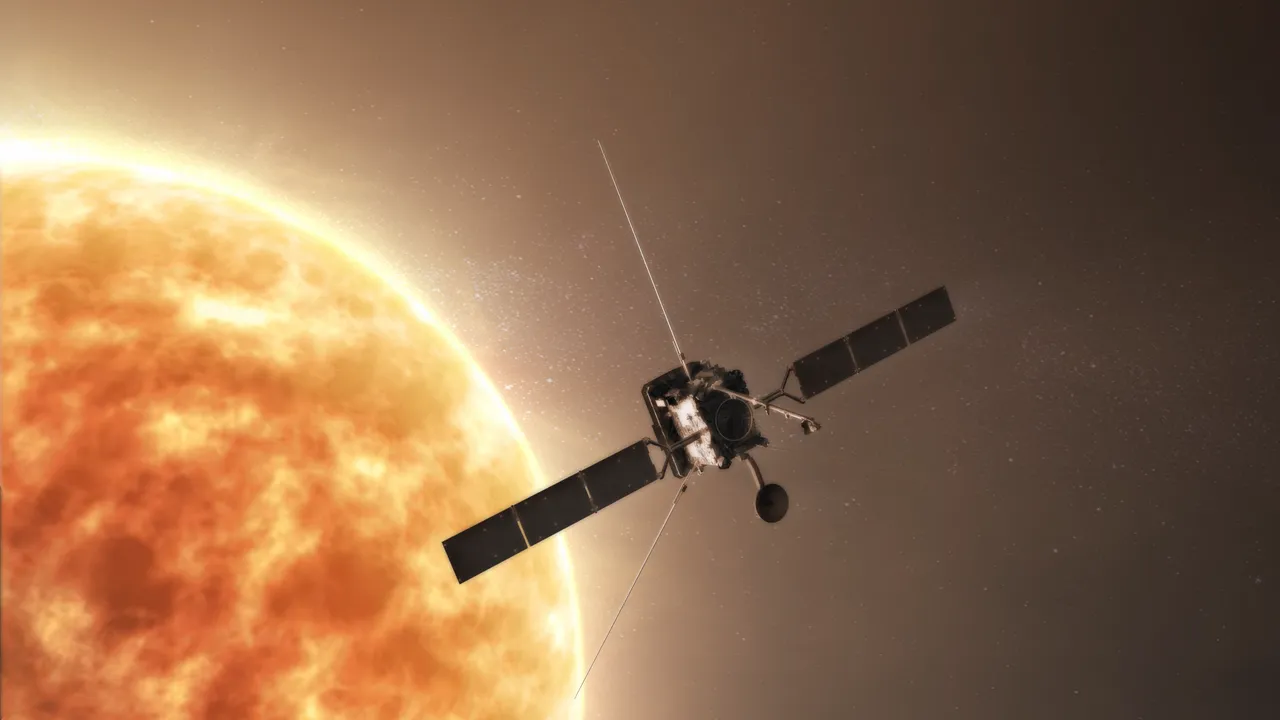
A team of scientists led by Dr. Yuhang Gao and Prof. Hui Tian at Peking University has identified high-frequency magnetic waves in the Sun's polar regions using data from the Solar Orbiter, a spacecraft that provides unprecedented views of the Sun's poles.
The researchers focused on solar plumes, which are ray-like magnetic structures extending from the Sun’s north pole. They observed a significant difference in the number of waves detected between Solar Orbiter and older instruments like NASA’s Solar Dynamics Observatory (SDO).
Solar Orbiter’s Extreme Ultraviolet Imager (EUI) captures images every five seconds with a resolution of 420 km per pixel, more than doubling the precision and speed of earlier instruments.
These high-frequency waves, which were previously undetected, may play a crucial role in powering the fast solar wind, a stream of charged particles that flows from the Sun at hundreds of kilometers per second.
The discovery could help scientists better understand the mechanisms that propel particles in the fast solar wind, a process that has been poorly understood.
The Solar Orbiter’s enhanced capabilities provide a clearer picture of the Sun's magnetic dynamics, potentially shedding light on the complex processes that govern solar activity.
What's still developing
- A new paper from a team led by Dr. Yuhang Gao and Prof. Hui Tian at Peking University, and published recently in the journal National Science Review, thinks they might have found an answer by using high-speed shots from Solar Orbiter to detect never-before seen rapid, high-frequency magnetic waves in those areas.
- Gao et al - High-frequency magnetohydrodynamic waves with substantial energy in the solar polar corona UT - The Solar Orbiter is Giving Us an Unprecedented Look at the Sun's Poles UT - We're Finally Seeing the Sun's Mixed Up Magnetism at its Poles Andy has been interested in space exploration ever since reading Pale Blue Dot in middle school.
- But there’s a lot we don’t know about how those highways actually work, and in particular how they give the particles that form the fast solar wind an extra “kick” that sends them zooming at hundreds of kilometers per second.