
Home · Science · Sep 18 archive
BepiColombo Mission Reveals Mercury's Solar Bombardment
Developing
In Short: During its fourth flyby, the ESA/JAXA mission detected high-energy particles from a solar eruption impacting Mercury's surface.
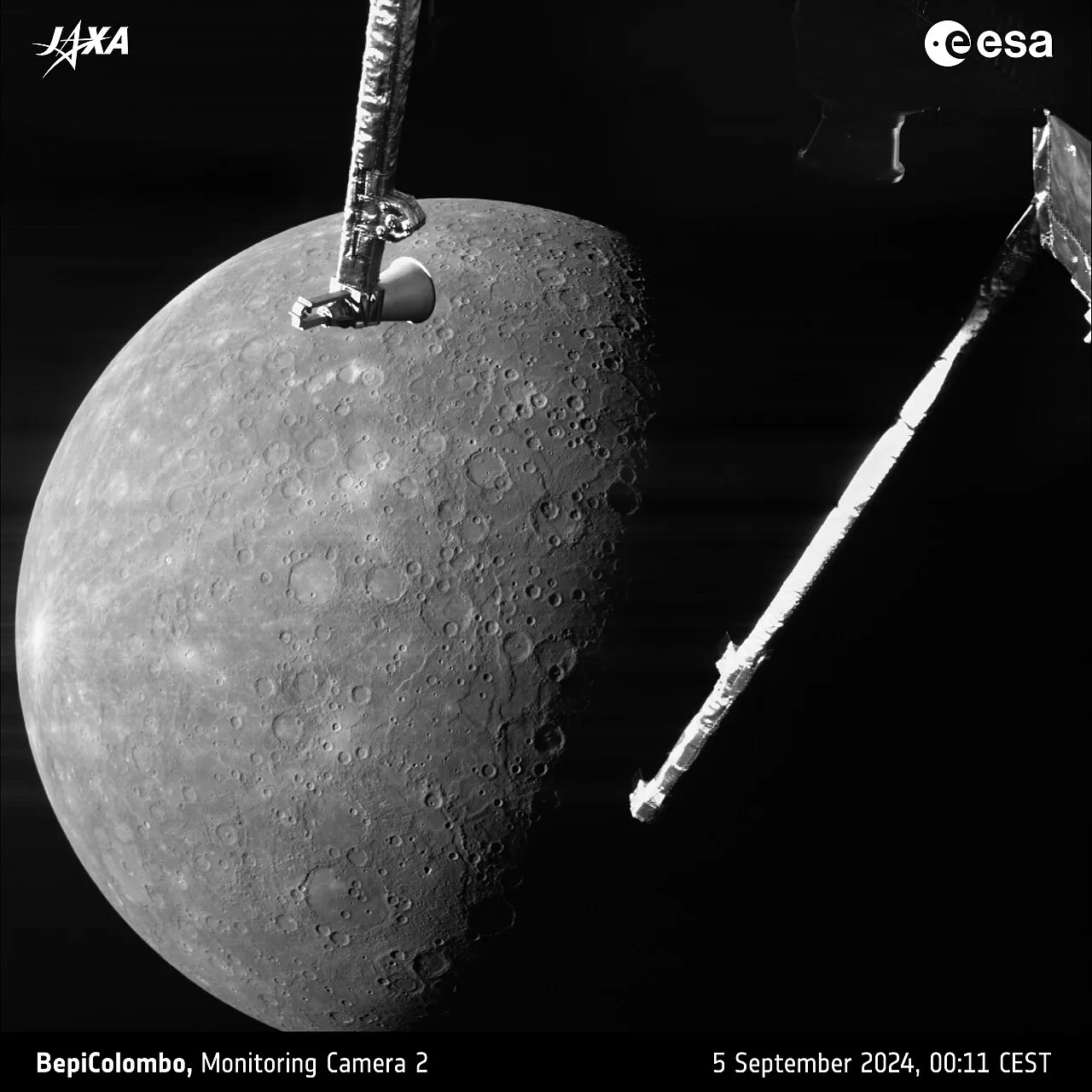
The ESA/JAXA BepiColombo mission, launched eight years ago, completed its fourth flyby of Mercury in September 2024, bringing the spacecraft within just 165 km of the planet's surface.
During this flyby, the Solar Intensity X-ray and Particles Spectrometer (SIXS) instrument detected a significant amount of high-energy particles from a solar eruption penetrating Mercury's magnetic field and reaching the planet's surface.
Co-Principal Investigator Rami Vainio, a professor of space physics at the University of Turku, noted that Mercury's magnetic field is weaker and its magnetosphere smaller compared to Earth's, making it more susceptible to solar particle bombardment.
The SIXS instrument revealed that during the eruption, high-energy particles covered a wide area on Mercury's surface, providing valuable data on how planets near their stars protect themselves from solar storms.
Each flyby of Mercury by BepiColombo has collected crucial information about one of the least explored planets in the Solar System, helping to address fundamental mysteries about the planet.
The mission's ongoing investigations include studying how solar charged particles and space storms impact Mercury, contributing to a deeper understanding of the planet's environment and its interaction with the Sun.
What's still developing
- This coincided with elevated fluxes of high-energy charged solar particles, giving astronomers the opportunity to study how planets close to their stars shield themselves.
Sources
- Universe Todaylink