
Home · World · Sep 17 archive
Lebanon, France Host Security Talks Amid UNIFIL Mandate End
Confirmed
In Short: Despite Lebanon and France both favoring an extension of the UN mandate, neither the US nor Israel has signaled support for prolonging the mission.
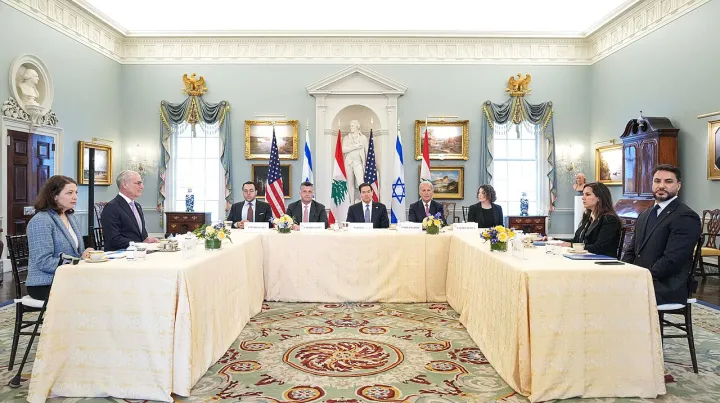
European and Arab military chiefs are meeting in Paris to discuss the Lebanese Armed Forces' needs and potential alternatives to the UN peacekeeping mission UNIFIL, amid fears of renewed Israeli military activity in southern Lebanon.
The United States is represented by a senior military official involved in Middle East security issues, according to Reuters.
On Wednesday night, Israeli forces carried out a series of attacks across southern Lebanon, according to Lebanon’s National News Agency.
Last week, Israeli air attacks killed at least 13 people, including six children, in a town in southern Lebanon, according to Lebanon’s Ministry of Public Health.
The security talks come as Israeli forces continue to carry out attacks across southern Lebanon despite a “ceasefire”.
Thursday’s talks will be chaired by French President Emmanuel Macron alongside Lebanese President Joseph Aoun and Jordan’s King Abdullah II.
The meetings come after Israel and Lebanon held several rounds of US-brokered talks aimed at easing tensions along their border.
The most immediate concern of the meeting in Paris will be the security vacuum that could be left when the UNIFIL mission, which has about 7,500 personnel, leaves in January.
The officials in Paris will discuss options for a new international mission, backed by France and Italy, operating outside a UN mandate, as well as a possible European Union-led mission.
Macron said that the talks aimed to 'strengthen Lebanon's sovereignty and enable it to fully ensure its security', after years during which political factions, such as the Shiite militant group Hezbollah, wielded greater authority than the Lebanese state.
The poorly equipped Lebanese forces have struggled to carry out their mission of disarming Hezbollah in the south, which is a key condition for Israel's withdrawal from southern Lebanon.
Lebanese Prime Minister Nawaf Salam’s meetings in New York on the sidelines of the 81st session of the UN General Assembly have so far failed to secure Lebanon’s request for a six-month extension of the UNIFIL mandate.
What this adds
The plan lacks guarantees, a UN or European mandate, and a clear legal framework for deployment.
Lebanon does not want a vacuum in the south, nor does it want to reach a stage where Israeli forces are directly confronting the Lebanese Army.
Background
French President Emmanuel Macron and leaders from Lebanon and Jordan met in Paris to discuss the future of the Lebanese Armed Forces and potential alternatives to the United Nations peacekeeping mission UNIFIL, amid fears of renewed Israeli military activity.
What's confirmed
- European and Arab military chiefs are meeting in Paris to assess the Lebanese Armed Forces’ needs and discuss the looming end of the United Nations peacekeeping mission UNIFIL, amid fears of a renewed Israeli military campaign in southern Lebanon.
- The United States will be represented by a senior military official involved in Middle East security issues, the Reuters news agency reported.
- Meanwhile, Israeli air attacks killed at least 13 people, including six children, in a town in southern Lebanon last week, according to Lebanon’s Ministry of Public Health, in one of the deadliest days of Israeli bombardment in recent weeks.
- Fears of a renewed Israeli military campaign are growing in Lebanon after escalating attacks, despite a “ceasefire” that was intended to halt Israeli aggression and allow the thousands of displaced people in Lebanon to return home.
- Thursday’s talks will initially be chaired by French President Emmanuel Macron alongside Lebanese President Joseph Aoun and Jordan’s King Abdullah II.
- The meetings come after Israel and Lebanon held several rounds of US-brokered talks aimed at easing tensions along their border.
- Despite Lebanon and France both favouring an extension of the UN mandate, neither the US nor Israel has signalled support for prolonging the mission.
- The officials in Paris will discuss options for a new international mission, backed by France and Italy, operating outside a UN mandate, as well as a possible European Union-led mission.
- The most immediate concern is how to fill the security vacuum that could be left when the UN peacekeeping force UNIFIL, which has about 7,500 personnel, begins drawing down from January.
- As part of the US-brokered talks, Israel and Lebanon agreed to a framework deal that envisions Israeli troops gradually withdrawing as Lebanese authorities disarm Hezbollah and deploy across the country’s south.
What's still developing
- A US-mediated framework deal was agreed between Israel and Lebanon in June, but the agreement did not force Israel to withdraw from the large area of southern Lebanon it occupies, and Israel has continued its attacks on the country.
- “Our societies are being shaken by new storms: the upheavals, caused by climate change, the erosion of democratic norms, and new threats to our sovereignty,” Canada’s Mark Carney said in a statement alongside France’s Emmanuel Macron on Sunday.
- Macron, whose government is facing increased pressure at home over rising fuel prices, said the talks had opened the door for bilateral discussions aimed at sealing concrete deals. Paris hopes Canada will broaden its exports of liquefied natural gas to Europe rather than primarily to Asia.
- The two leaders also discussed Canada’s relationship with the EU after the bloc proposed that Ottawa become its first associate member, something Macron said France supported.
- More than a decade after the EU and Canada agreed to the Comprehensive Economic and Trade Agreement, and nine years after its provisional application began, several EU member states have yet to ratify the accord, including France.
- For France, Saint-Pierre and Miquelon is strategically important due to its location on the doorstep of the US and the Arctic.
- The territory also occupies a key place in France’s cooperation with Canada, including over energy.
- But he said security guarantees would be required as well as a dignified post-war peace.
- Kushner told the Ukrainian president that Trump was “very determined to see an end of this war”, and thanked the UK, Germany and France for their efforts in trying to achieve peace.
- While Witkoff and Kushner were in talks at the Kremlin on Saturday, Zelensky said he and his team were “ready for a substantive conversation”.
- Saturday’s talks in Moscow lasted three hours and were held behind closed doors in Putin’s official residence in the heart of the Russian capital, according to Russian state media.
- “The talks were not limited to an exchange of views on resolving the Ukrainian crisis – economic issues and potential major, mutually beneficial Russian-American projects were discussed in considerable detail,” he said.