
Home · Science
Inouye Solar Telescope confirms tiny Kelvin–Helmholtz vortices on the Sun
Confirmed
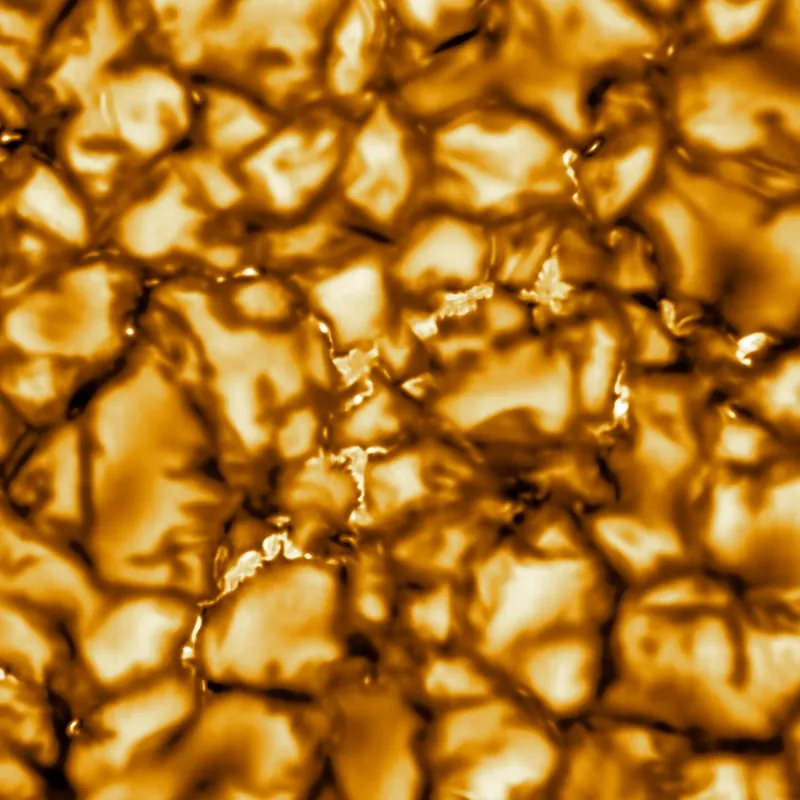
What we know
Using the NSF Daniel K. Inouye Solar Telescope on Maui, an NSO / NCAR HAO / Max Planck MPS team published Nature results confirming ubiquitous Kelvin–Helmholtz instabilities on the solar photosphere — tiny plasma vortices roughly 25–170 km across along magnetic–granule boundaries.
The structures were long predicted but below the resolution of smaller telescopes. Authors say the twisting helps braid magnetic fields and may transport energy toward the million-degree corona, a piece of the long-standing coronal-heating puzzle.
What's confirmed
- Nature paper (Kuridze et al.): “Ubiquitous Kelvin–Helmholtz instabilities driving plasma mixing on the Sun” (DOI 10.1038/s41586-026-10871-3).
- NSO press release: DKIST 4-meter telescope; observations at 416 nm; first unambiguous experimental confirmation of photospheric KHI.
- phys.org / Ars Technica / Astronomy magazine: vortex sizes ~25–170 km; spacing often ~60–100 km; growth on ~minute timescales.
What's still developing
- How much of coronal heating these photospheric KHIs ultimately explain versus other mechanisms.
- Follow-on DKIST campaigns quantifying energy flux from the vortices.
Sources
- National Solar Observatory — Inouye enables discovery of hidden solar process (KHI) link
- phys.org — Tiny vortices discovered on the sun's surface link
- Ars Technica — World's biggest solar telescope caught vortexes on the Sun's surface link
- Astronomy magazine — World's largest solar telescope reveals the Sun’s hidden texture link
- Nature — Ubiquitous Kelvin–Helmholtz instabilities driving plasma mixing on the Sun link