
Home · Science
Curiosity finds vast honeycomb polygon field in Mars Valle Grande
Confirmed
What we know
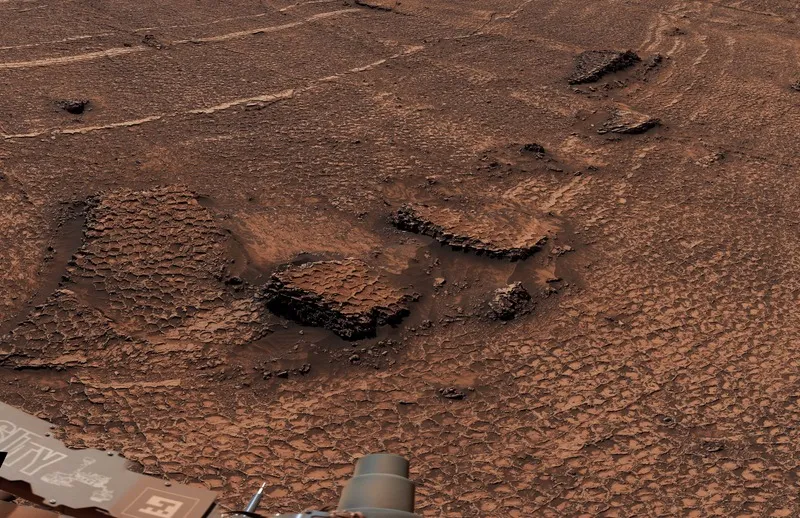
NASA’s Curiosity rover, climbing Mount Sharp foothills through a valley nicknamed Valle Grande, returned a 360-degree Mastcam panorama on sols 4,930–4,931 (June 19–20, 2026) showing honeycomb polygonal fractures spanning the scene — far larger in areal extent than prior small patches the mission had seen.
Individual polygons measure about 4–8 centimeters (1.5–3 inches). They wrap a ~6-meter sand-capped butte nicknamed Miraflores. Formation processes under study include mud cracks from wet–dry cycles, temperature cycling, and sediment compaction/dewatering after burial.
What's confirmed
- NASA / JPL (Jul. 29 feature; phys.org Aug. 22 recirculation): Valle Grande panorama shows polygons in all directions; Miraflores butte context; project scientist Ashwin Vasavada quoted on scale of the find.
- NASA Science photojournal: Mastcam mosaic sols 4930–4931; polygon diameters roughly 5–10 cm in caption variants; scientists measuring traits to discriminate formation mechanisms.
- Popular Science / SciTechDaily corroborate NASA facts and Mount Sharp ascent context (rover landed Aug. 5, 2012).
What's still developing
- Which process (or mix) formed the Valle Grande field — mud crack vs freeze–thaw vs compaction.
- Follow-on chemistry/contact science at the site as Curiosity continues the climb.
Sources
- NASA — Curiosity discovers field of honeycomb textures link
- NASA Science — Curiosity discovers a field of Martian polygons (photojournal) link
- phys.org — Mars Curiosity rover discovers massive field of polygons link
- Popular Science — Curiosity rover spots ancient sea of Martian polygons link
- SciTechDaily — Curiosity finds vast sea of mysterious polygons on Mars link